
How Zohran Mamdani is convincing New York’s capitalists to give a little socialism a chance
Zohran Mamdani has not, it turns out, attempted to seize the means of production. At least not yet.
During his mayoral campaign, you couldn’t throw a stone without hitting a CEO worried about the effect he’d have on the city’s economy. After his first year in office, business is proceeding as usual, which—New Yorkers being New Yorkers—means that everyone is feeling angsty.
“I was very concerned when he was elected,” says Neil Blumenthal, cofounder and co-CEO of the nearly $3 billion eyewear company Warby Parker, headquartered in New York. Now Blumenthal is waiting to see what the most senior member of the Democratic Socialists of America in the city, if not the country, will do.
“The DSA’s official policies . . . include things like government takeover of private companies, increasing income taxes, and abolishing the police. Publicly, he’s said some things to moderate those positions,” Blumenthal says. “[But] at times he’s advocating for some of those policies, which are deeply unpopular and aren’t going to lead to growth and prosperity.”
Still, 15 chief executives have kept open enough minds to join the mayor’s Business Advisory Council. The group represents more than 100,000 employees in industries spanning real estate, film, sports, and healthcare.
It includes Hamdi Ulukaya, the billionaire CEO of Chobani, who advocates for immigrants and once played street soccer with the mayor. It also includes numerous doubters and former naysayers. There’s the real estate CEO who gave $250,000 to Mamdani’s mayoral opponent, Andrew Cuomo. The investor who wrote an op-ed saying that Mamdani would bankrupt the city. The former bank CEO who talks on Fox News about “prioritizing capitalism.” The chair of the finance committee of a hospital where Mamdani supported striking workers.
Mamdani is bringing startup culture to government
These titans of industry may not support every facet of the mayor’s ambitious plans, but they’ve signed on to his broad vision of building a better functioning, more affordable New York. Their first meeting, in September, kicked off with an icebreaker about their first jobs, and they discussed a key point of alignment with the mayor’s agenda: The high cost of housing and childcare is making it difficult to hire in New York. (Neither Mamdani nor the council members agreed to be interviewed for this story, though top administration figures happily did.)
“I’ve seen this TV series for a lot of episodes,” says Anthony Shorris, head of the New York City Economic Development Corporation (NYCEDC), the city’s primary economic development vehicle. Shorris has worked alongside business leaders, often as a public servant, since the 1980s. “They love mayors, they get mad at mayors, whatever. At the end of the day, I think what they really care about is the city’s economy being strong.”
Mamdani has brought an undeniable sense of energy and optimism to the job, which had “been missing for quite a while,” says Shorris.
He’s also brought some much-needed elements of startup culture to city government. That includes quick response times, vibrant interactive marketing campaigns, improved city websites, and hands-on servant leadership. He tackled certain small—sometimes symbolic—things right away, such as filling potholes quickly (the city has fixed more than 200,000 so far in 2026, more than it did the entire year prior, under Eric Adams), replacing nets in basketball hoops, offering free opera tickets, creating public viewings for World Cup and Knicks playoff games, providing evening childcare for parents who need a night out, and installing modular public bathrooms.
It’s part of a larger plan. When constituents “feel a greater sense of confidence in government, that gives us more room to tackle even bigger things that people in the past have not thought of as the fundamental basic role of government,” says Julie Su, in the newly titled position of deputy mayor for economic justice.
Even skeptical business leaders can see that Mamdani currently enjoys an eye-popping 69% approval rating. All five of the ballot initiatives he championed——like speeding up bike lane projects and construction—passed handily.
In the aftermath of a generational wave of Democratic victories at every level of government across every part of the country during the midterms (including eight DSA members elected to Congress), it’s hard to generalize about what, exactly, individual voters were responding to. But Mamdani’s relentless focus on affordability was echoed by politicians across the Democratic Party.
And fear that Mamdani’s vocal support of democratic socialism would haunt Democrats was certainly misplaced. Earlier in the year, House Speaker Mike Johnson threatened to make him the face of the national Democratic Party in order to drag down Democratic chances in Middle America. Today, aligning with Mamdani is a PR win, though some leaders will keep queuing up “mad at mayor” episodes no matter what.
But as Mamdani moves past these early victories and begins tackling his more ambitious agenda, the détente that’s existed with the business community since his inauguration is starting to be tested.
His to-do list is long and only fractionally complete: city-owned grocery stores, free childcare for 2-year-olds, faster buses (with a plan to make them free, which would require state-government support), expanded access to union organizing, rent freezes for one- and two-year leases (roughly 1 million units total, about 40% of the city’s rental units), a pathway for citizens to sue businesses or landlords they feel are breaking the law, zoning rules that make it easier to build new (and more affordable) apartments, fewer hurdles and fines around small business operation, and the enforcement of city laws, like winning a recent $131.5 million action against DoorDash for underpaying delivery workers.
And then there are his even grander plans, some of which have a more quintessentially “eat the rich” bent: a “pied-à-terre tax” on expensive second homes in the city (that remains tangled in legal challenges), increased minimum wage, and higher taxes on the wealthy and corporations—all of which require support from a state government less aligned with his vision.
What the city’s CEOs really think about their mayor
The business impact of Mamdani’s agenda won’t be measured in immediate increases to market cap or earnings per share. It will be felt obliquely. Corporations benefit when employees can access affordable housing and childcare and customers have disposable income to purchase their products.
America’s captains of industry know this. Despite the rending of garments before the election last year about New York turning into Soviet Russia, many of them took similar positions not long ago.
The Business Roundtable, comprising some of the largest corporations in America, issued passionate statements in 2019 about the value of stakeholder capitalism, the same year that Bank of America CEO Brian Moynihan touted large wage increases for workers and Salesforce CEO Marc Benioff proclaimed that “capitalism as we know it is dead.” Recently, CEO Scott Kirby of United Airlines told The New York Times that “wealth inequality has become a danger to our society, and we need to address that. We should have a national wealth tax.”
After the midterms, other leaders began giving voice to such values. Appearing on CNBC the day after the election, Uber CEO Dara Khosrowshahi noted: “If you look over the past 20 years, return on capital has increased very, very significantly. You can’t say the same thing about return on labor.” (Continues…)
To pursue his daring agenda, Mamdani has put some ballast in place. In addition to deputy mayor Su, who led the U.S. Department of Labor as acting secretary for two years under President Biden, Mamdani brought on Shorris, a former first deputy mayor under Bill de Blasio and Port Authority executive director, to be the president and CEO of the NYCEDC.
He’s paired with new NYCEDC board chair Lina Khan, the former Federal Trade Commission chair known for finding ways businesses were crushing regular people and regulating them out of existence, making her a bugbear of corporate interests. Khan tells me via email that she’s focused on wielding the NYCEDC’s toolkit to grow “the economy in a way that delivers affordability, widespread prosperity, and real opportunity.”
The next three years—or seven, should Mamdani be reelected—could end up being nothing but a tense standoff. Or they could usher in the most progressive economic intervention since the New Deal. I spoke with members of the administration, business leaders, political insiders, and policy experts carrying out parts of his agenda to answer a fundamental question of his first term: whether the democratic socialism that propelled Mamdani to victory can coexist with the capitalist engine powering the financial heart of America.
Democratic socialism and its deep-pocketed foes
What does it mean, in practice, for Mamdani to be a democratic socialist? It’s tricky: Ask two socialists to define socialism and you’ll get five answers.
Mamdani gave his most digestible definition in October to podcaster Theo Von: “Socialism means you will have whatever you need to live a dignified life—and that it is the government’s job to deliver on that.”
For many, the sentiment has become a rallying cry. Since he became mayor, DSA membership has grown to more than 120,000 nationwide—the New York chapter now includes 15,000 members, more than the entire national organization had in 2016. (Full disclosure: I’m a former member of the San Francisco chapter of DSA and a former union organizer. I’ve also been a business editor for more than a decade—a living embodiment of the tension I’m writing about here.)
Mamdani has tapped into a sense that socialism “really cares about excellence,” says Corey Robin, a political science professor at Brooklyn College. His vision “gives people a hint of the kinds of things that the government can provide to make life better, not as a default for what the private sector doesn’t provide, but perhaps as a baseline of what we can all expect for everybody.”
If the opposition to Mamdani’s movement has a spiritual home base, it might be outside Citadel CEO Ken Griffin’s 24,000-square-foot four-floor penthouse on the southern edge of New York’s Central Park.
To announce the pied-à-terre tax—which would tax second homes in New York valued by the city as $5 million or more for houses and $1 million or more for condos and co-ops (at rates between 0.8% and 6.5%)—the mayor released a video of himself standing in front of the hedge fund leader’s second home and crowing about the tax dollars Griffin would soon be paying. The tax, Mamdani said, was “designed for the richest of the rich: those who store their wealth in New York City real estate but don’t actually live here.” The video’s soundtrack sounded remarkably similar to the theme song from HBO’s Succession.
For some in the upper echelons of industry, it was a bridge too far. “New York City is the financial home of the world, and to have a mayor that truly believes that capitalism and jobs are evil . . . publicly humiliating Ken Griffin and actively trying to drive [him] away is a pretty terrible outcome for the day-to-day New Yorkers who need jobs,” says Bradley Tusk, a venture capitalist and political consultant who worked in Mayor Michael Bloomberg’s administration. “More tax revenue means you can help more poor people. . . . Instead, he is actively pushing people away.”
Mamdani “was playing to his base and sending a negative message,” says James Whelan, president of the Real Estate Board of New York (REBNY), a trade group that represents some 14,000 members. “We want people to invest here in the city, create jobs here. There was no upside to that video in terms of what was in the city’s best interest.”
Hedge fund manager Bill Ackman called the video “a huge mistake” at Fast Company’s Innovation Festival in September. He admonished the mayor for having “scared away or encouraged people who are among the most productive New Yorkers to go to other places, like Miami.”
Griffin himself claimed that the video “put me in harm’s way” and threatened to halt plans to build a new Citadel headquarters in Midtown.
Compared to the rhetoric coming out of D.C., Mamdani’s video seems tame—and comes nowhere near the language that, say, FDR used when talking about the “economic royalists” of his era, according to Robin, the Brooklyn College professor. Yet there’s still the question of the mayor’s other tax proposals.
During the campaign, Mamdani teased a slate of increases: raising the income tax by 2% on people earning more than $1 million (projected to raise $4 billion annually), adjusting property taxes so wealthier property owners pay more, and raising the state’s corporate tax rate on some businesses from 7.25% to 11.5% to match neighboring New Jersey’s (projected to raise $5 billion a year).
But only the state legislature and Governor Kathy Hochul can raise these taxes. And while she supported the pied-à-terre tax, Hochul seems currently uninterested in signing any other large tax proposals. (On Election Day, when asked if he had spoken to the governor about new tax proposals during her next term, Mamdani sidestepped the question).
In some ways, it’s all a bit of theater. The mayor can energize supporters by calling for a tax he can’t raise. CEOs can wring hands about the possibility of a tax that will not be enacted. But business leaders hate uncertainty, so “words matter,” says Blumenthal. “If we are trying to make New York City the best place to build a business, and you are telling folks, ‘Hey, we’re going to be raising taxes’ or are generally promoting an anti-business sentiment, those business leaders have lots of options” in terms of moving to other cities, he warns.
“It’s cordial.”
While evidence of people and businesses fleeing the city will take years to quantify, initial numbers don’t scream of any danger. Available office space just fell to its lowest level since 2020, and in the second quarter, contracts on $10 million to $20 million properties were up nearly 40% over the same period last year.
Despite Griffin’s protests, he’s continuing his Midtown office project. Ackman announced plans to open a $660 million brain research institute on the city’s West Side. Higher corporate tax rates could certainly drive businesses away, or suppress entrepreneurship, but Mamdani’s proposal was aimed at the highest-earning companies; a new startup would be exempt.
Is Warby Parker toying with the idea of leaving? “We’re a New York brand, so we’re here, and we’re going to do everything possible to continue to invest in this city,” Blumenthal says, citing the company’s continued charitable commitment to give free glasses to New York schoolchildren.
Everybody’s Business: When it comes to his economic vision for New York, Mayor Zohran Mamdani is surrounded by supporters and detractors. Yet everyone’s got to find a way to work together, at least for the next three years. A look at who’s who among this smart, engaged, and very motley crew.
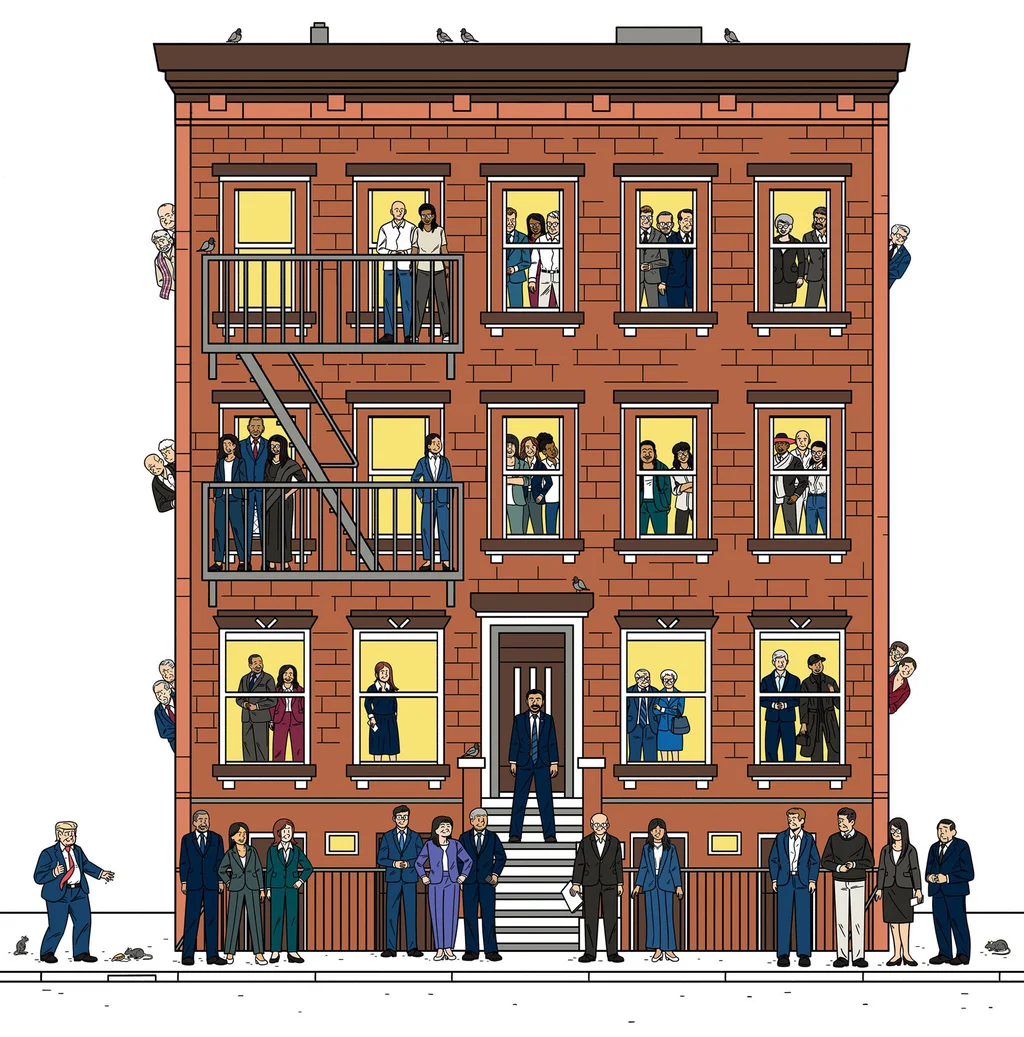
Some of the tension seems entirely avoidable. Business leaders, used to knowing what levers to pull and what phone call to make, are having trouble getting used to an administration that isn’t as focused on the usual glad-handing. “He’s so charismatic that if he was willing to spend a little bit of time meeting with VCs, with startups, he could make them feel good about being here,” says Tusk.
“Many in the business community, myself included, would love to see a more pro-business approach,” says Julie Samuels, the president and CEO of Tech:NYC, a trade group that represents the city’s tech industry. Even so, she acknowledges, the administration is making an effort: “There is outreach.”
It helps that the city’s vibes have been good. The Knicks’ championship run, which prompted a jaded populace to party in the streets, coupled with the mayor’s constant barrage of smiling, feel-good videos about small wins (another pothole filled!) have created a sense of possibility. “As long as New York is a place where people want to live, tech companies will continue to expand and hire here,” says Samuels. Plus, “this administration is, especially at an interpersonal level, very pleasant. That goes a long way for those of us who work in this space.”
(“It’s good that we communicate,” says Steven Fulop, the president and CEO of the nonprofit Partnership for New York City, which represents more than 300 of the city’s largest corporations, who is often deeply critical of the administration. “It’s cordial.”)
“There’s certainly common ground, and that’s not always reported,” deputy mayor Su says. A big part of her job involves meeting with CEOs—and sometimes cleaning up. She happened to have a meeting scheduled with Whelan the day after the Griffin video dropped. “It went fine,” says Whelan.
Su cites the Business Advisory Council as evidence of the administration’s willingness to engage with some of its biggest critics: “This is not a performative exercise” but “a real desire to learn from one another.” Those don’t sound like the words of an administration that’s trying to end private capital. But that doesn’t mean another video targeting the 1% is off the table.
Mamdani’s grocery plan: “I think it’s incredibly stupid, but it’s at least a real attempt at socialism”
Errol Schweizer remembers being shocked when he saw the video. In December 2024, Mamdani, then a long-shot candidate running for mayor of New York, promised that if he won, he’d open city-owned grocery stores. There were scant details about how this might work, but it sounded like a revolutionary idea.
“He pulled it out of his ass,” jokes Schweizer, a consultant and former food executive who hosts the Grocery Nerds podcast. “There was nothing else to it. He was like, ‘We’re going to open five publicly owned grocery stores.’” For Schweizer, though, it resonated. A former vice president of the grocery division of Whole Foods, he has been writing about the logistics of city-owned groceries for years.
Schweizer eventually got in touch with the campaign and, after Mamdani’s election, helped the NYCEDC design the city’s $70 million pilot program. The five outposts, the first of which is slated to open by late 2027, will be spread across the five boroughs and be run by private operators. The administration says they’ll charge 30% less on average than nearby stores on all fresh produce, meat, seafood, and roughly 20 additional categories of pantry staples, dairy, and refrigerated goods.
Of all the administration’s projects, the grocery stores are the most forward- looking and traditionally “socialist.” They’ve also drawn the most criticism. The grocery business has infamously tight margins, and since the plan is for the city to make payments to the store operator to compensate for its losses, critics say the stores will cost the city too much to subsidize. Even many left-leaning wonks say there are simpler alternatives to lowering the price of food for needy New Yorkers, like increasing payments to existing food-subsidy programs.
Schweizer says the existence of other options misses the point. By controlling the grocery stores, the city gets to play a role in the supply chain. If the cost of food is adding to the city’s affordability crisis, the administration doesn’t want to let private operators or other market forces exclusively determine that cost. “New York does a lot of this stuff already in other sectors,” says Schweizer. Its ferry system, for instance, is publicly owned but outsourced to private operators. In this case, public institutions become “a primary purchaser of food for customers,” he says.
As one of the most radical of the administration’s proposals, the stores have become a lightning rod. “I think it’s incredibly stupid, but it’s at least a real attempt at socialism,” says Tusk. A coalition of small grocery stores and the National Supermarket Association have both sued the city, saying the plan is illegally anti-competition. In response to the proposal, John Catsimatidis, the billionaire owner and CEO of supermarket chain Gristedes, threatened to close his stores if Mamdani won the election. (He is also a former Republican mayoral candidate and the owner of a right-wing radio station, so he may not be motivated strictly by the bottom line.)
Schweizer acknowledges that the stores will have an impact on surrounding businesses, which the city will need to mitigate, perhaps with additional subsidies. But he sees an upside for the city’s economy: “There are 1.5 million New Yorkers who are food insecure.” And they spend money too. “That is an enormous customer base that’s not being serviced by the current market. It’s a market failure.”
In a few years, there will be data—and it won’t require much complex analysis. “The measure of success here is, will people shop?” says Schweizer.
It’s just one example of how the city may intervene in the local economy. One of the next “failed markets” the city is looking at fixing, Shorris says, is building insurance, which drives up the cost of housing development. Additional new initiatives could address “monopolistic practices or limited suppliers,” he says. “We want to look at the range of tools we have—regulatory, policymaking, use of our land and resources, investment, and scale—to see if we can create opportunities that the market might not [be creating] for the people we’re concerned about.”
The symbolism of toilets
“Everyone would tell us, ‘Oh man, New York City, it’ll take, minimum, a year and a half to get something through the procurement process, and that’s going to be a slog,’” says Jessica Heinzelman. As the cofounder and COO of Throne Labs, which has installed modular restrooms in six U.S. markets, she had been eyeing New York for years but thought the red tape would be daunting.
Then free public toilets appeared on the mayor’s agenda for his first 100 days. Five weeks after the inauguration, a request went out for proposals, and Throne—which sells toilet stalls that operate on a 10-minute timer and don’t require water lines or electricity hookups—won. By September 16, Throne was installing the first of what will be 17 units as part of a one-year, $4 million pilot. (Heinzelman says OSHA rules prevented the mayor from helping install a toilet himself at the launch event. When she suggested they stage it, she was told Mamdani won’t do anything fake.)
This is not the speed at which cities usually move—even one that never sleeps. The mayor, says Shorris, “is impatient” and devotes a lot of attention to the “key areas that were commitments of his.” The business world is noticing. “Obviously, what they’re doing and saying is resonating with a lot of New Yorkers,” says Samuels, of Tech:NYC. “And a lot of people in tech, particularly on the investor side, see that and want to know what’s going on. What is it that’s resonating?”
Take, for example, the city’s Parents’ Night Out babysitting project. One Sunday in August, rec centers around the city opened from 4 p.m. to 8 p.m. for children ages 6 to 13, providing free activities and childcare for up to nearly 300 registered children. In a city of 8 million, 300 sets of parents getting four hours off is an almost meaningless statistic. But that a government would even think of it is the point.
That may have been a one-off event, but childcare is a top issue for the administration, and an area where it’s forging some of its most productive relationships with business leaders.
With a year of childcare now costing sometimes even more than a year of college, the mayor worked with the governor to launch a pilot expanding former mayor de Blasio’s universal 3-K program—which in 2017 seemed revolutionary but is now part of the city fabric—to 2-year-olds, up to 10 hours a day, 260 days a year. Initially, the program will serve roughly 2,000 children, with plans to expand to 12,000 by fall 2027. After that, it becomes a question of how to pay for more, with business leaders likely to balk at raising taxes.
What’s interesting is that everyone—even business leaders put off by the mayor’s socialism—seems to agree that childcare should be free, a public good provided by the city.
In September, a group of businesses—including the Partnership for New York City, Tech:NYC, and REBNY—established the NYC Child Care Business Council to advocate for public investment in childcare. “The market is not able to solve this problem,” says Grace Rauh, executive director of Citizens Union, which is home to the 5BORO Institute, a New York policy think tank that convened the group. “Frankly, private businesses aren’t able to provide the kind of fully robust childcare benefits that their employees need.” But they increasingly recognize, she says, that for the city’s economy to grow and for it to attract the best talent, “we need affordable and accessible childcare.”
Mamdani’s real estate turnaround
Not everyone is satisfied with the administration’s overall pace of change. Andrew Rigie, executive director of the New York City Hospitality Alliance, which represents restaurants, bars, and clubs, feels that Mamdani’s OPEN for Small Business initiative—more than 50 proposals for eliminating red tape and fines—doesn’t go far enough. “While none of them are bad,” he says, “they’re certainly not transformative.”
But even some of Mamdani’s fiercest critics are realizing the benefits of a city that makes things happen. Two months before the mayoral election, an email circulated among housing developers, the Times reported: “If we fail to mobilize, the financial capital of the world risks being handed over to a socialist this November. We cannot—and will not—let that happen.”
But Mamdani, who once advocated for “moving toward the full de-commodification of housing,” came around over the next several months to the potential of private real estate development, citing building booms in Austin and Minneapolis that seemed to lower rents. The Economist declared in September, nine months into his administration, that “developers are learning to love Zohran Mamdani.” REBNY’s Whelan confirms it (while also decrying the rent freeze and Mamdani’s “punitive” attitude toward building owners): “When it comes to the issue of housing production, our goals are aligned,” he tells me. “We have a housing-supply issue here in New York City. The mayor has ambitious goals, and he should. Now it’s a matter of whether execution will meet ambition.”
The real estate industry certainly supports Mamdani’s effort to speed up permits and building approvals and his goal to increase supply by 200,000 new affordable apartments over the next decade. That’s a lot of new business for developers. “Real estate is an asset class that can’t move” out of the city, says Whelan. “So it’s in our interest for the city to succeed. If this mayor makes progress in making the city more affordable, creating more housing, we’re going to be a more competitive city, and the real estate industry is going to be stronger.”
Mamdani has even seemingly charmed New York’s most legendary real estate developer, receiving gushing praise from President Trump at joint appearances in recent months despite the president’s once calling him a “100% Communist Lunatic.”
Trump has also given him a template for one of his biggest moves since he took office: having the NYCEDC invest $29 million into the building of a quantum lab at New York University. In return, the city will take 15% of any future revenue from the IP generated on city-funded equipment. A few years ago, this would have seemed like a radical socialist endeavor. But given that the president has spent the past two years negotiating equity stakes for the federal government in major tech and mineral companies (including a nearly 10% stake in Intel), this deal feels positively quaint as an act of government intervention.
The quantum computing arrangement is a prime example of how the NYCEDC will be thinking about its bigger economic development projects. “This mayor’s made pretty clear what his priority is, which is to find opportunities for growth that advance the objective of social justice,” Shorris says. Some projects will be solely about creating jobs, and others—like the grocery stores—will be focused on improving economic opportunity. But the ideal one will sit in the middle. “I don’t think the growth and justice objectives are incompatible,” Shorris says.
Good vibes, it turns out, are good for business
Since Mamdani’s electrifying mayoral run, politicians across the country have tried to emulate his video strategy, with limited success (just ask Mayor Karen Bass in Los Angeles, whose own pothole video failed to land). They’re having better luck on the policy front: delivering key services while gently prying the capitalist system open to greater government control.
In Boston, Mayor Michelle Wu is clashing with business interests over tax increases and development, while testing programs like free buses. She crushed her most recent primary challenger, the son of New England Patriots owner Robert Kraft, by 49 points.
In L.A., city council member and DSA-endorsee Nithya Raman, running for mayor on a strikingly Mamdani-esque platform of improving city services and increasing housing development while focusing on the city’s lower-income residents, defeated Bass, the incumbent—while Washington, D.C. and Providence, Rhode Island, also elected new socialist mayors.
(On the other hand, Brandon Johnson, the Chicago mayor whose own grocery pilot failed, and Katie Wilson, the recently elected socialist mayor of Seattle, are floundering, hinting that ideology must be paired with execution to fully inspire.)
A quarter of the way into his term, Mamdani has yet to be tested by a crisis or severe economic downturn. The AI bubble could pop, the bond market is creaky, and tensions between him and his base about policing—and the continued employment of Police Commissioner Jessica Tisch—could crest. (Retaining Tisch from the previous administration was universally cited by business leaders I spoke with as the best decision he’s made, making her seem like a foundational piece of any bridges being built.)
Meanwhile, in order to enact some of his most progressive proposals, he’ll have to persuade state-level lawmakers to support and pay for them—and face down corporate leaders. “He hasn’t yet had the kinds of confrontations with private capital that are going to have to happen for some of these big changes to happen,” says Robin, the Brooklyn College professor. But political capital is currency: A near-70% approval rating means you have room to try things.
“There’s tremendous power inside government agencies that has not been fully utilized for the good of the many, to build an economy for the many,” says deputy mayor Su. If more politicians figure out how to unleash it, the movement could gain even more traction—in New York and elsewhere.
By doing things like cutting red tape for small business and appointing chief savings officers to eliminate wasteful spending in city departments, while also pushing city-owned grocery stores and universal childcare, perhaps the mayor has replaced the usual binary of “more government” or “less government” with a new paradigm: Can we find the right amount of government to solve each problem?
Industry leaders can help answer that question. Billionaires, industry groups, and corporate lobbying arms spent tens of millions of dollars trying to prevent Mamdani from being elected. Now, they’re trying to figure out their place in a city where his agenda (or, at least, his presentation of his agenda) has become quite popular. Good vibes, it turns out, are good for business. So are functioning cities, and employees who aren’t struggling to afford housing, childcare, and groceries. Mamdani’s success could end up saving capitalism in New York from the die-hard capitalists themselves.
Wary business leaders have a list of indicators they’re watching to determine the administration’s success. Have jobs left the city? Is the number of millionaires increasing? Is new housing being built? “Does New York become a better place to build a business, raise a family, and invest for the future?” offers Blumenthal, citing New York’s shrinking population. “Is homelessness down? Are reading scores significantly better? Are the streets safer and cleaner?”
Shorris says the vision is to hit those metrics. “A New York that spreads its benefits across all of its people has been and can continue to be the most powerful economic engine anywhere,” he says. There’s a place at the table for business leaders to help build that city under a democratic socialist administration. They’re just going to have to get used to the fact that they’re no longer the ones controlling the agenda.
内容来自 Fast Company,版权归原作者所有。
阅读原文 ↗