
Govt's school transport hike should be revisited - cttee
Updated / Thursday, 26 Nov 2026 16:34
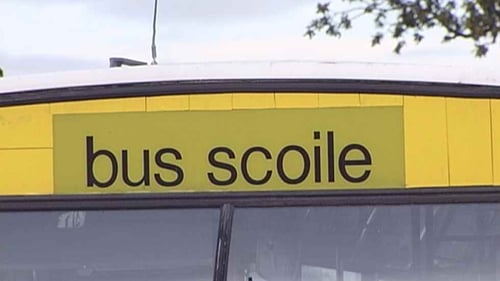
The Chair of the Oireachtas Education Committee has said it is his belief the Government's decision to increase school transport fares for families will have to be revisited.
Fine Gael's Cathal Crowe was speaking as officials from the Department of Education and Youth addressed the committee on operational issues related to the school transport scheme.
"I appreciate that it is largely a political issue and not for us to go through today, but it is my belief that this will have to be revisited," Mr Crowe said.
He said it is "a very unrealistic thing to be loading" on families.
He added that parents across the country were finding it hard to absorb the idea of a fares being increased at a time when "cost of living issues were very much back in their homes again".
Fares were reduced as a cost of living measure in 2022, but as part of October's budget the Government decided that they will return to 2021/2022 levels from next September.
Post-primary fares are also rising from €100 to €350 for the 2027/2028 academic year.

At the committee hearing, Department of Education and Youth officials said school bus transport is subsidised by the State to the tune of 93% at primary level and 75% at post-primary level.
Assistant General Secretary Martin Clohessy said it costs between €1,400 and €1,500 a year to carry a child on a school bus.
Yesterday, Taoiseach Micheál Martin indicated the Government may review some of the planned increases.
This came after Independent TDs and ministers supporting the Government expressed opposition to the increased charges on Tuesday, saying a more modest increase would provide much needed relief for families.
But last week in the Dáil, the Tánaiste and Fine Gael leader Simon Harris ruled out reversing the Government's decision.
He noted the need to ensure a more efficient school transport system.
The committee hearing focused on operational challenges facing the system, including the underutilisation of services by children who have bus places, inflationary cost pressures and moves to implement recommendations made in a review of the system, which was published two years ago.
Officials said changes to the system needed to be introduced carefully otherwise it would be overwhelmed.
Referring to the underutilisation of the scheme where children allocated much sought after seats were not using those seats on a regular basis, Mr Crowe asked was a "use it or lose it" policy being considered.
Principal Officer Sinéad McDonnell said this was something the department was currently working on, but it was essential that data would be gathered first and that this was proving very challenging.

Since 2020, the cost of school transport has increased by 58%, the committee heard.
The projected cost for next year is €687 million.
Within the overall cost, €143 million is being spent on taxis to carry children with special needs to their nearest suitable schools.
The committee heard the department will go to tender in the first half of next year for a new software system to monitor the scheme.
The committee agreed to write to the Department of Education to express concern at a disparity in eligibility for the scheme between certain kinds of primary and post-primary level schools.
Primary school children who wish to bypass their local Catholic or other religious run school to attend a multi-denominational school are eligible for free bus transport, but post-primary students are not.
At post-primary level student may only bypass a closer school to attend a minority religion school.
The issue was raised by People Before Profit-Solidarity TD Ruth Coppinger.
The TD said the disparity was unfair and discriminatory and a problem for people in a number of areas.
She requested the committee write to the Department of Education and Youth about the matter.
Calling it old fashioned and backwards, Jennifer Cummins, of the Social Democrat TD, said the system was "stuck in the 1960s".
Department officials said they were working on updating the wording related to this.
Mr Clohessy said the department was working through the recommendations of the review.
"If you introduce something you could completely overwhelm the system," he said.
"What we are trying to do is increase eligibility, but do it in a sustainable way," he added.
More stories on

内容来自 RTE,版权归原作者所有。
阅读原文 ↗