
This retro light control panel is pure nerd joy—and I want it
Somewhere inside a hollowed-out volcano, a bald man stroking a white cat is playing a Barry White LP and dimming down his lair’s halogens with the F4 lighting console. Or perhaps operating an orbital weapon. I want one. The control panel. The orbital weapon, too. Maybe a synthetic polar bear rug while we’re at it.
Designed and made by Sacrebleu, a one-person workshop in Washington state run by Alex Dufetel, the F4 is a home automation console that resembles a tiny audio mixing board. The 13 x 7.5 x 3.5-inch device has four motorized faders, a fat aluminum knob, four metal keys, and a small screen, all wrapped in walnut.
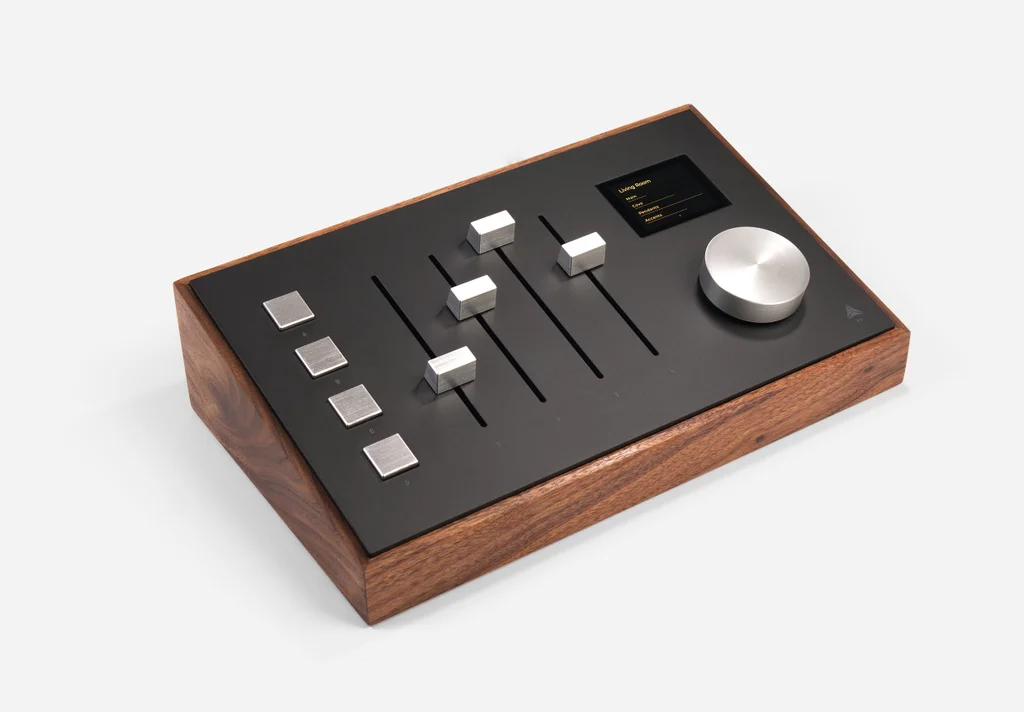
It costs $1,700. It does absolutely nothing my phone can’t already do, but who cares. I just can’t resist the ’70s vibes. And physical controls are just better. While manufacturers avoid them to save on costs, many people want them back. As Dufetel tells me, “Our hands want physical feedback: something to push against, and a response they can feel.”
Dufetel used to run a Meta team working on how people interact with virtual and augmented reality (remember Zuck’s metaverse?). The F4 is 2,000% a much better use of his talent and time. Just look at the faders. They work like the motorized sliders on a big recording studio desk. They move by themselves. If you dim your original 1962 Flos Arco lamp—because, if you have $1,700 to sink into a lighting console, you have an original Arco lamp—in your living room using your phone’s home automation app, the matching fader glides down following your finger.
The big knob allows you to dim a whole room in one go or, with a press, connect to another room in your house. When you do that, the four faders slide into place to mirror that room’s lights. If you move a fader, your phone will reflect the change. And, if you put a thumb on a fader midslide, the motor simply gives up. “Your hand wins,” as the company puts it.
Overengineered for Warp 9 nerd joy
Each of the faders can run a single lamp or a group of lamps. You can also set them to change color temperature or even color instead of brightness, if your light can produce different hues.
The four metal keys are for saved scenes, four per room.
Oh, and if a light doesn’t dim, the fader goes into what Dufetel calls “snap mode”: it fights your thumb for a moment, then slams to the end of its travel, imitating the way a toggle does it. There’s no spring or detent inside. “The motor does all of it,” Dufetel tells me. As you push, the motor pushes back harder and harder, “then past a certain point it lets go and drives the fader the rest of the way, so it snaps over like a wall switch.” He tuned that feel by hand at his bench.
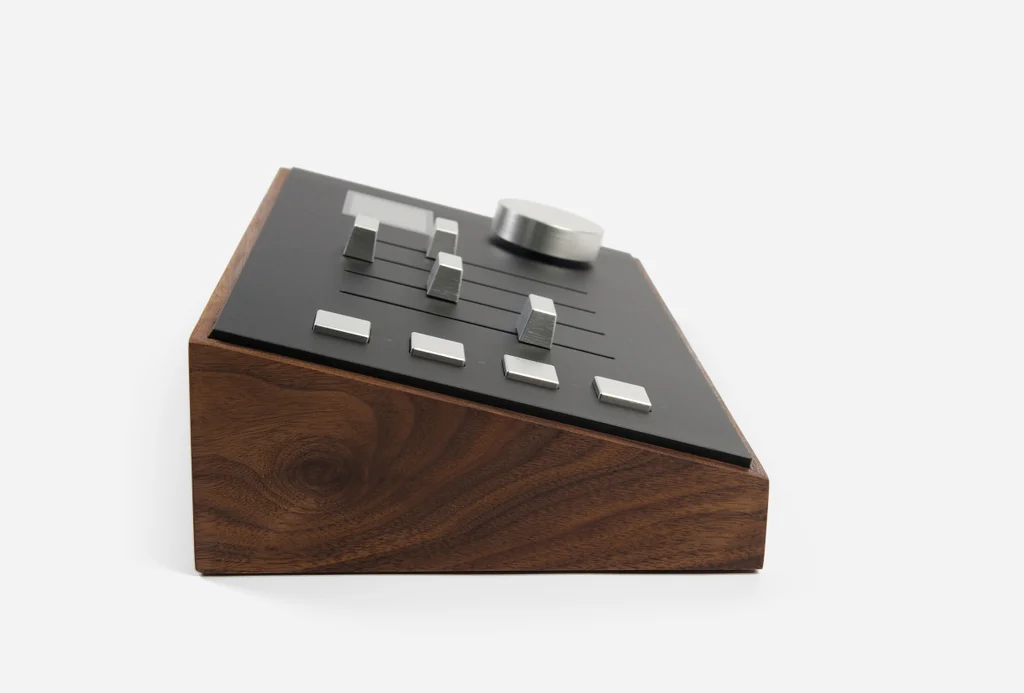
It doesn’t stop at lighting. You can use the knob as a volume dial for Sonos or any other speaker hooked up to Home Assistant. The 2.4-inch AMOLED screen shows the track information, because of course it does. It’s small and mostly monochrome on purpose, though. “The screen isn’t meant to be the hero of the product,” Dufetel says. The F4 talks to the hub you probably already own, whether it’s Philips Hue, Lutron Caséta, or Home Assistant, the open-source platform that can run lights from Ikea, Lifx, Nanoleaf, and others.
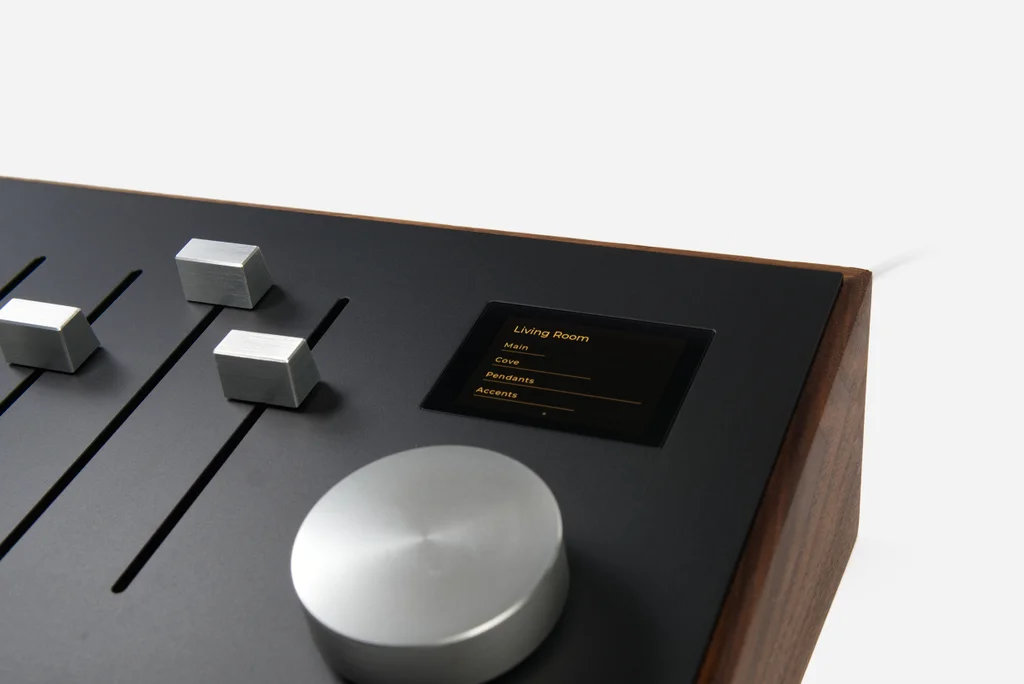
Dufetel writes that the console grew out of “a nostalgia for old hi-fi gear: solid materials, and controls you could feel.” He tells me that, if he had to name one influence from the stereos he grew up with, he says, “it would be the old Marantz receivers, with their wood cases and aluminum controls.” The four faders come from Alps, a Japanese component maker, he says in his FAQ. The keys are NKK switches. According to the designer, the knob, key caps, and front panel are anodized aluminum cut from solid stock. The oiled walnut case comes out of his workshop near Seattle, its four sides mitered from a single plank “so the grain wraps around the corners,” he tells me. He designed it to stay on the table for decades.
Sacrebleu is taking $50 refundable deposits on 100 units, with shipping beginning sometime after March 2027 to the U.S. and Canada for now (you can add your name to an international waiting list). It comes with a two-year warranty and a 30-day return window.
My favorite thing about Dufetel’s physical gadget pitch is the last item in his FAQ: “Couldn’t I just use my phone to control my lights?” The answer is three words long: “Yes, you could.” Would Blofeld use a phone app to control his laser to kill Bond? Yeah. Exactly.
内容来自 Fast Company,版权归原作者所有。
阅读原文 ↗