
Guest post: 20 years later, reflections on the retracted Lancet case report about codeine use and breastfeeding

In 2005, Parvaz Madadi was a graduate student in pharmacology and toxicology at Western University in London, Ontario, studying under Gideon Koren, a once-renowned pediatrician and pharmacologist who would later resign and lose his medical license amid misconduct allegations. Madadi started working with Koren just before the publication of the now-retracted 2006 case report in The Lancet on an infant’s death from opioid poisoning, reported in the paper as the result of morphine exposure through breast milk. Madadi would go on to coauthor several papers with Koren on the topic.
Following interviews with journalist Ben Taub for an article in the New Yorker, Madadi revisited her emails from that era and contacted The Lancet on issues related to the case and requesting the journal retract the article. After an institutional investigation, The Lancet retracted the case report on Nov. 19. In this guest post, Madadi, a forensic scientist and writer, reflects on her role in that retraction, and events from 20 years ago.
This moment brings reflection on my evolving understanding of this case report over these past 20 years: from a graduate student who defended this publication, to a forensic toxicologist who worked in death investigations, to a mother who can more deeply appreciate the relational frameworks that inform this story.
Today, the retraction of this publication is a win for advocates of transparency in science. Very simply put, this case report was missing important toxicology findings; these details were relevant to interpreting the case and would have informed the scientific discourse that followed.

However, this was by no means a simple case report. It was a complex interplay of forensic casework, maternal-neonatal pharmacology, and, at the time, cutting edge pharmacogenetic research. At its core was the tragic death of an infant and a family who had experienced a traumatic loss.
The Lancet published this case report as a bench-side finding with direct significance to bedside practice, yet the report did not provide caveats or limitations inherent with this extrapolation. Following publication, the case report formed the basis of public health advisories in North America. Subsequently, an anonymous research participant became publicly identified and took on a role as a scientific advocate. When Nicholas Bateman and others began to question the forensic details underpinning the study’s conclusions, a death investigation that was closed also became the subject of scientific scrutiny and speculation.
As the lead and corresponding author of The Lancet paper, Gideon Koren was faced with both ethical and scientific challenges with his interpretation of this case study. As his master’s student, I became drawn into the controversy by being given lead authorship in columns he had written, based on his original Lancet submission, for publication in Canadian Family Physician and Canadian Pharmacists Journal.
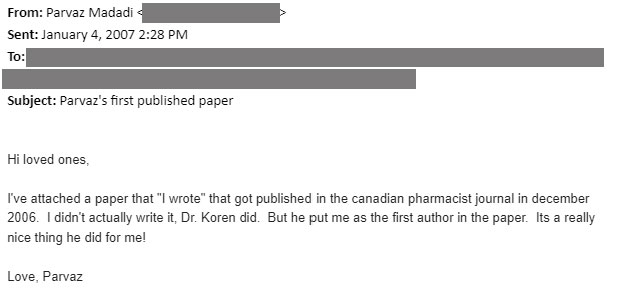
As a junior researcher just starting my academic journey, I perceived a gifted first authorship from my supervisor as a benevolent offering. In retrospect, Koren had departed from standard practice on authorship order based on contributions and also brought me into the forefront of a forensic case study, with all the implications that come with first authorship. More subtly, it was from that point forward that Koren began to refer to The Lancet case report as “ours,” and over time, I assumed responsibility for defending a case report I had neither formulated or written.
Years later, I conducted a large research study with the coroner’s office, and trained and worked as a forensic toxicologist myself. I came to appreciate the intricacies of death investigations and the precision that is needed when drawing conclusions. One of the main pillars of training for forensic scientists is to recognize your positionality: not only to clearly state what your area of expertise is, but to be aware of the limits to your scope and knowledge. More intrinsically, forensic scientists must be open to any new evidence that is presented and constantly self-reflect on potential rigidity in their scientific positions.
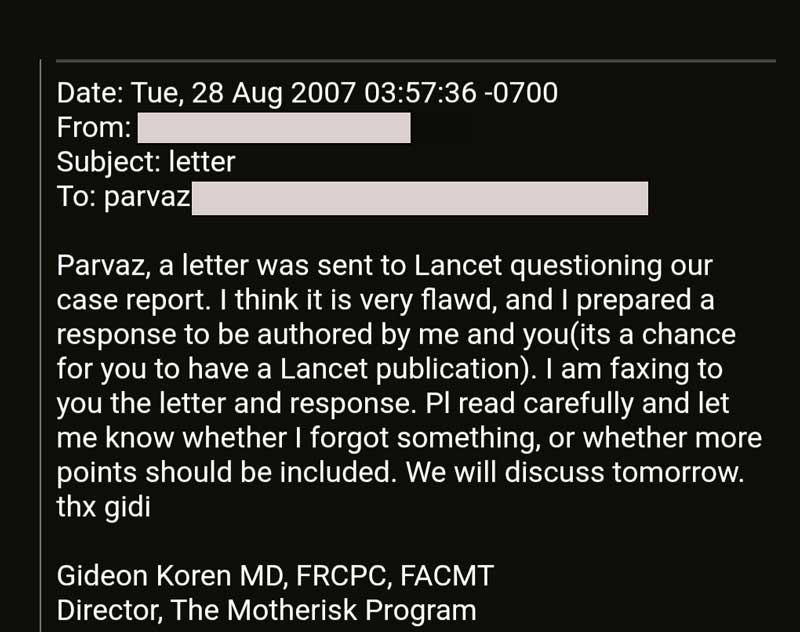
When I revisited this case report last year, in conversation with Ben Taub of the New Yorker, I found myself in a place of greater clarity in regards to the layers of this case. As I considered the information Taub presented, the case history and codeine gastric toxicology information he shared caused me pause. I subsequently went back to old emails to try and understand how this information had been missed. During this process, I identified additional ethical, technical and authorship concerns and raised these issues to The Lancet. The SickKids Research Integrity Office subsequently conducted an investigation and concluded that the omission of material toxicology data constituted falsification. Ultimately, this finding became the central basis for Lancet’s decision to retract the paper.
Twenty years later, I have come to appreciate the power of scientific discourse. Inquiring scientific minds had questions about this case, and through the contributions of Bateman, David Juurlink, Taub, and others, the dialogue was sustained with great perseverance. At the same time, this case inspired new research and insight in the field of pediatric pharmacology. A substantial body of literature has emerged from this case report, including epidemiological, observational, and modelling studies examining the safety of maternal opioid use during breastfeeding. The totality of the evidence from these studies now needs to be critically synthesized to inform best practice guidelines for breastfeeding mothers.
From my perspective, the core of this journey has been all about transparency. Meaningful scientific discourse requires the disclosure of all relevant evidence from which we draw our scientific conclusions. The retraction of this case report has confirmed and addressed the foundational importance of this issue.
Yet there is another more subtle thread of transparency, and that is to recognize how relational frameworks can influence the way we interpret, present, and defend scientific data. Authorship, mentorship, scientific prestige, areas of expertise, and even advocacy; for breastfeeding mothers, for a research participant; for a deceased infant — these are the subtle threads of positionality which have woven the tapestry of this case study for 20 years.
Like Retraction Watch? You can make a tax-deductible contribution to support our work, follow us on X or Bluesky, like us on Facebook, follow us on LinkedIn, add us to your RSS reader, or subscribe to our daily digest. If you find a retraction that’s not in our database, you can let us know here. For comments or feedback, email us at team@retractionwatch.com.
内容来自 Retraction Watch,版权归原作者所有。
阅读原文 ↗