
AN INQUEST HAS heard how an Irish Army captain and his colleagues took to fields in South Lebanon as they were fired on as they tried to fix a blown-out tyre en route to get closer to the location where Private Sean Rooney’s vehicle was under attack.
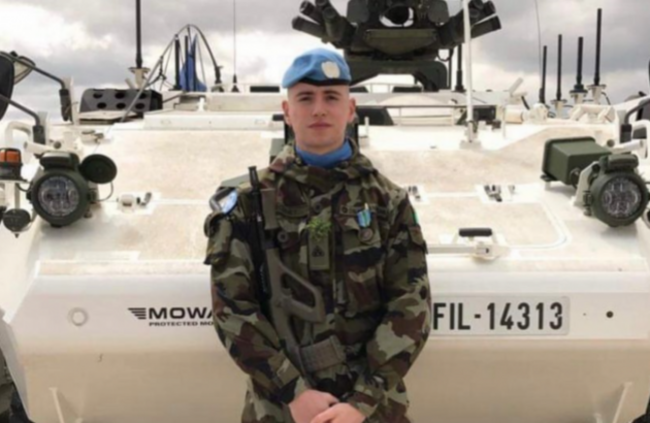
Captain David Kelly, who had 12 years of experience, led the convoy in which Rooney (24) was killed in an incident in South Lebanon on 14 December 2022 while he was on peacekeeping duty. He was in car one, while car two was driven by Rooney.
Kelly’s deposition was read into evidence today at the inquest into the killing of the Irish soldier in Dublin before coroner Dr Myra Cullinane and a jury of four men and seven women.
Repeatedly, throughout today’s evidence, members of the press were excluded from the inquest as coroner Myra Cullinane agreed with counsel for the Defence Forces that allowing this information into the public domain could risk the safety of Irish troops.
The process in the coroner’s inquest means that the deposition is read first, and then he answers questions by counsel for the deceased’s family and the Defence Forces.
The convoy
In a dramatic telling of the incident Kelly told investigators that he was in charge of a convoy that would bring two soldiers to Beirut airport so they could return to family funerals in Ireland.
He said that he was the second-in-command of the reconnaissance element at UNP 2-45, or Camp Shamrock, when he was ordered to lead a two-vehicle transfer of the two personnel to the Lebanese capital.
Kelly’s deposition said that it was decided to travel on board Administrative Utility Vehicles (AUV) – essentially two armoured-style Toyota Land Cruisers.
As has been heard at the inquest in previous days, from other soldiers, the convoy team had a short briefing before leaving the Irish base at UNP 2-45. His evidence was that in the briefing he said that he verbally told the drivers where the route they would take.
They travelled then through the hilly terrain to the coast. Along the way his evidence was that they passed through a village where there were large numbers of people watching a high-profile match on television.
As they neared the coast, and the highway, they stopped at a location known as EP28 to change their flags from United Nations peacekeepers pennants to Irish tricolours.
The inquest again heard that after this was completed, the convoy asked for permission to head north out of the UNIFIL area of operations towards Beirut.
Kelly echoed the evidence of other witnesses that it was shortly after this point that he realised that the car being driven by Sean Rooney was not following them. This was at 11.45pm.
The captain said he saw that the “side profile of the car” behind his vehicle was a different type of car, and it was then he realised they had lost contact with Rooney’s vehicle.
He spoke about backing down a dual carriageway to try to establish contact with the Rooney car. He also said he made a series of phone calls to Corporal Josh Phelan trying to rendezvous with them.
Phelan sent screengrabs from Google Maps to show Kelly where their vehicle was located.
He spoke about several phone calls during which he told Phelan and Rooney how to escape their predicament.
The car Rooney was driving was suffering a Denial of Freedom of Movement, known in military speak as a DFOM.
Screaming
When he heard screaming from his colleagues in the Rooney car which was trapped and under attack he contacted the Tactical Operations Centre at the Irish base and asked for permission to go and help them.
The last transmission from the trapped car included screams of “they’re in” and then the phone went dead. He said this was at approximately 11.16pm.
Kelly ordered his car to make its way direct to the location where Rooney’s land cruiser was trapped.
His deposition said that while driving at speed the vehicle suffered a blowout in one of its tyres. He said that this was a regular occurrence and that it had happened on a number of occasions because the tyres of the armoured cars were unable to sustain high speeds.
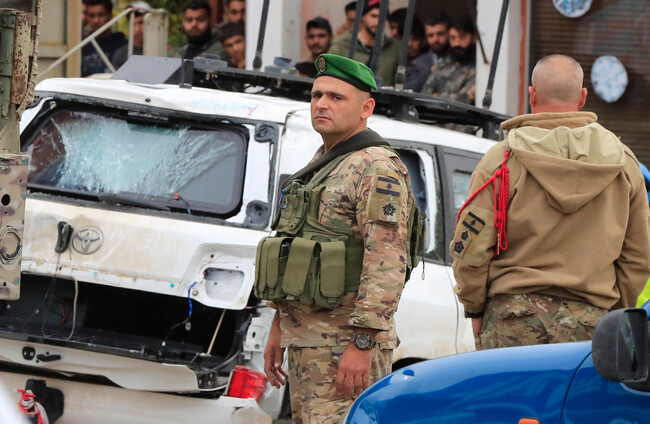
The captain said he and his team tried to fix the blown tyre, but then they were approached by a dark-coloured saloon vehicle. He heard shots in the direction of the vehicle, and they used their own car as cover.
He said that the attackers also tried to record them. They took cover in a ditch. Kelly said he continued to call Josh Phelan but that there was no answer.
‘Darkness of the field’
His plan was to get back on foot to EP28 and while they were doing that they were again being approached by vehicles – he then decided to “hide in the darkness of the field”.
He said by the time he made contact with troops he was informed of the death of an Irish soldier. He said earlier that a Lebanese Armed Forces (LAF) officer refused to help but later it was the LAF that assisted them.
Earlier in the day, Gunner Jordan Tarrant Lowry had continued his evidence. He repeatedly said he could not recall details as he was questioned by Seán Guerin SC for the relatives of Seán Rooney.
Lowry, who was in the first car with Kelly, took notes on his phone of events as they unfolded; they were shown to the inquest.
In it, he recorded times and details and the actions of the people in the car.
Under questioning from Guerin, it was explained that Kelly had referred to ISIS camps as they passed through the country.
The case continues with David Kelly’s questioning on Wednesday.