
Inquiry told Finucane killed for work challenging state
Updated / Tuesday, 24 Nov 2026 14:47
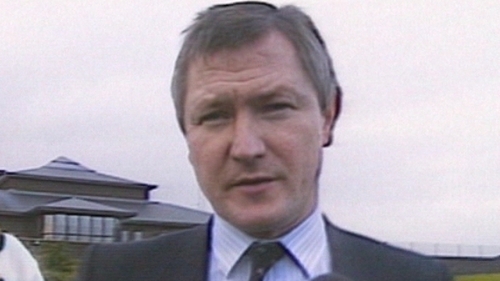
Belfast solicitor Pat Finucane was murdered because he was an effective lawyer who challenged the work of the state in Northern Ireland, the public inquiry into his killing has heard.
The inquiry is hearing from counsel for the family Danny Friedman KC.
He is setting out in detail the family's position in relation to the murder.
"The reason Patrick Finucane was killed is because he was a lawyer and an effective one whose work had come to pose an increasing challenge to the security forces that operated in Ireland at the time," Mr Friedman told the inquiry, sitting in Belfast.
Mr Friedman told the inquiry that in particular Mr Finucane's work in relation to a series of state killings in the early 1980s was "part of the chain of events" that led to his death.
Mr Finucane represented families of those killed in the so-called shoot to kill deaths of republicans in Co Armagh.
He was seeking to have the officers who opened fire compelled to give evidence to the inquests, something that was being resisted by the state which had announced that there would be no prosecutions.
Mr Finucane was murdered around the same time that he was having some success in the courts in respect of these cases.
Mr Friedman said Mr Finucane's wife Geraldine was not interested in those who had murdered her husband.
She wanted to know how high up the chain of command the conspiracy had gone.

Mr Friedman said there was several previous investigations into the murder which pre-dated the inquiry.
But at every turn, he said, information had been withheld, undermining their ability to conduct a transparent investigation and dragging out the issue.
"Every inquiry was told it had everything," Mr Friedman said, going on to provide examples of how that had not been the case.
This public inquiry was established to investigate the extent of British state collusion in the killing.
Mr Finucane was shot dead by the Ulster Defence Association (UDA) in front of his family at his north Belfast home in February 1989.
His wife was also injured.
It was later established that he had been targeted by British Army agent Brian Nelson.
The UDA quartermaster who supplied the murder weapons, William Stobie, worked for the Royal Ulster Constabulary (RUC).
Both are now dead.
One of the killers Ken Barrett confessed his role in the murder to police. He was then recruited as an RUC Special Branch agent.
The inquiry is being chaired by Gary Hickinbottom.
It opened last month with counsel to the inquiry setting out what was already known about the background to the murder.
Later counsel for three former RUC officers who had investigated Mr Finuncane's murder addressed the inquiry.
Clair Dobbin KC said her clients, Johston Browne, Trevor McIlwraith and Alan Simpson, were the only former State employees who had been given Core Participant Status.
Mr Browne and Mr McIlwraith were CID officers who investigated the killing, Alan Simpson is a former senior officer, a detective superintendent, who had headed up the murder inquiry.
Ms Dobbin said her three clients had already given their version of the events of the time including in television documentaries and books.
"They are invested in the ability of this inquiry to get to the truth and they want to play their part in its revelation."
She said Mr Simpson had never been told of the role of agents William Stobie and Brian Nelson in the murder plot.
"Their evidence gives rise to questions that have never been answered," she told the inquiry.
And she said there was a particular onus on the inquiry to establish the full truth in circumstances where there had been a deliberate attempt to conceal it through lies, the destruction or theft of evidence and the keeping of inaccurate records.
She said people would find it "chilling" the extent to which some public servants, including senior ones, had gone to, to conceal what had happened.
All of this had occurred in an atmosphere where the protection of agents had been more important than the detection of crime, she said.
Tomorrow the inquiry will hear for counsel for the British government and the PSNI.
More stories on

内容来自 RTE,版权归原作者所有。
阅读原文 ↗