
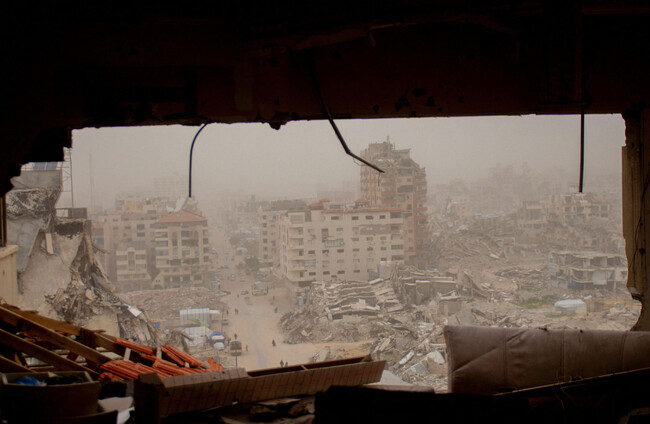
ALMOST ALL OF Gaza shows indicators of toxic contamination resulting from Israel’s use of weapons across the Strip, a report from Oxfam has found.
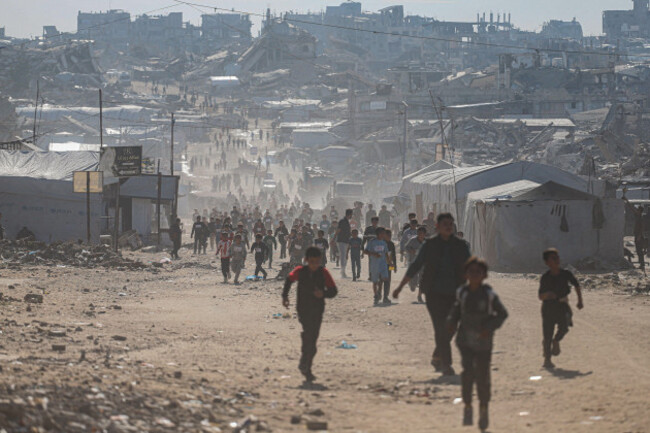
Three years into Israel’s full-scale assault on Gaza after the 7 October attacks, around 65% of the territory’s population, or 1.4 million people, now live in tents or makeshift shelters, according to the UN’s humanitarian agency.
Around 74,000 Palestinians have been killed in the conflict, according to figures provided by the Gaza health ministry, which the UN considers to be accurate.
Jointly authored by the charity and the Conflict and Environment Observatory, today’s report said military strikes, fires, destruction of buildings and environmental systems have contaminated the air, soil and water throughout Gaza.
The 125-page report examines the devastating environmental impacts of Israel’s attacks on the Palestinian strip.
“Since October 2023, Israel’s military has subjected Gaza to a sustained military assault of extraordinary scale and intensity, inflicting a humanitarian and environmental catastrophe through the excessive use of explosive weapons in one of the most densely populated areas in the world,” it reads.
Environmental impacts
The report examines individually the destruction of the quality of air, water, environmental control, food and soil and the health of civilians.
Researchers availed of satellite-derived data, remote sensing analysis, and geolocated conflict incident databases to spatially map contamination risks across Gaza.
They concluded that there is available evidence that can sufficiently conclude that contamination is “widespread, severe and consequential”, as well as raising serious concerns under international law.
Israel’s miliary onslaught has affected around 78% of Gaza’s land area. Indicators of potential contamination were identified across more than 99% of the territory.
Heavy metals, explosive residues, asbestos from destroyed buildings, dioxins and biological contaminants have dismantled the “basic conditions necessary for life”, researchers said.
Among its most stark findings were the detection of faecal coliforms – a bacterium caused by faecal waste from humans and warm-blooded animals – at a rate nearly 10 times more than that reported in 2021.
Exposure to faecal coliforms can cause gastrointestinal illnesses, skin and ear infections, and in more serious cases, liver and systemic infections.
Analysis of testing data found faecal coliforms in 19% of the 79 groundwater wells sampled across Gaza in July 2026.
Only 19% of sewage pumping systems remain functional. This has led to approximately 40,000m³ of raw sewage being poured into the Mediterranean Sea each day, the report said.
Dust and debris from flattened buildings has also generated pollutants, it said.
There are high risks of drinking-water contamination in North Gaza, Gaza City and Deir al-Balah. Remaining operational wells and desalination in these areas overlap with “highly vulnerable” groundwater systems, and areas of heavy bombardment and debris accumulation.
People in Gaza are facing growing respiratory health risks from dust and pollution caused both by the destruction of buildings and the burning of waste.
Recommendations
On the findings of its report, Oxfam called for the government of Israel to end its genocide in Gaza and immediately cease unlawful attacks. The charity said Israel should comply with the Geneva Conventions and lift all restrictions on the entry of humanitarian assistance, environmental assessment teams and essential materials.
It also called for Israel to disclose the information required to enable an accurate environmental assessment and to make full reparations for environmental and related harm caused by its wrongful acts.
The State of Palestine must hold a decision-making role over environmental standards, assessment, remediation, monitoring and spatial planning, Oxfam added.
Oxfam Ireland’s chief executive Jim Clarken said the report paints a “devastating picture” of the long-term environmental damage inflicted upon Gaza.
“Beyond the immediate loss of life and destruction during this ongoing genocide, we are seeing a breakdown of the very systems people depend on to survive,” he said.
“Without urgent action to assess, clean up and remediate this contamination, the consequences for public health and human wellbeing will be felt for generations.
“Reconstruction cannot simply mean replacing buildings and infrastructure. A thorough environmental assessment, led with Palestinian participation and expertise, must be an integral part of recovery efforts.
“Rebuilding without tackling these environmental risks would leave future generations to bear the costs of today’s destruction.”
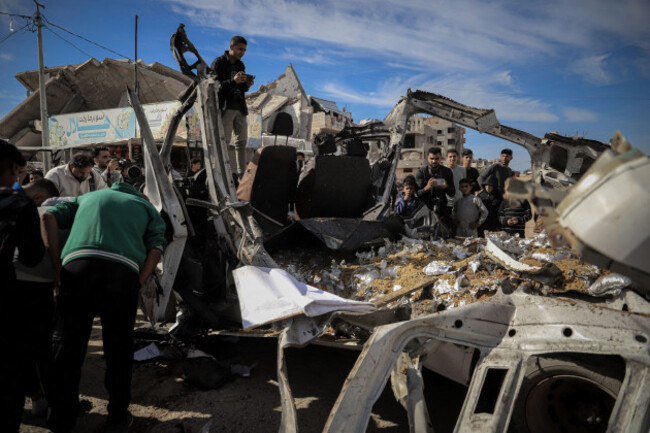
The UN Environment Programme estimates that Israel’s military operations have generated more than 61 million tonnes of debris across the territory.
It has turned Gaza’s destroyed homes, neighbourhoods and infrastructure into a vast reservoir of potentially hazardous materials, Clarken said.
He said the recovery and reconstruction of Gaza must be “owned and led by Palestinians themselves”.