
Fossil fuel dispute leaves climate talks deadlocked
A FIGHT OVER fossil fuels has threatened to derail UN climate talks as nations push back against a proposed agreement that scraps any mention of planet-heating coal, oil and gas.
Negotiations dragged into extra time after the summit in Turkey sailed past Friday’s scheduled closing time, with talks through the night failing to break the impasse.
COP31 co-hosts Australia and Turkey are scrambling to produce a revised draft deal as time runs out and delegates prepare to leave after two weeks of exhaustive negotiations.
“Getting bogged down in individual words and expressions and undermining this process serves no one’s interests,” said COP31 President and Turkish Environment Minister Murat Kurum, who urged countries to “act responsibly” and compromise.
Expectations of a major breakthrough in the Turkish city of Antalya have been low as countries grapple with an oil price shock and geopolitical tensions stemming from the war in Iran.
The summit follows a string of climate-linked disasters from Europe to Nepal and Indonesia and unfolds as a super El Niño pattern amplifies the risk of further extreme weather.
A draft climate deal unveiled earlier this week called for a faster phase-out of fossil fuels but a second, pared-down version released Thursday stripped away all mentions of coal, oil and gas.
‘Red lines’
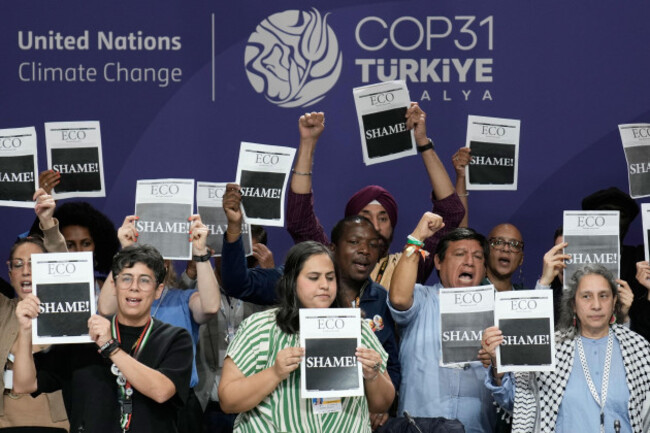
Fossil fuels are the main driver of climate change but a flashpoint at the UN talks. Their omission from the draft sparked protests and threats to walk away from the table.
“That is a red line for us. We’re talking about the root cause of all of this,” Tuvalu’s Climate Minister Maina Talia told reporters.
Talia, whose low-lying Pacific nation is threatened by rising sea levels, said if the world cannot address fossil fuels “then we are wasting our time here”.
When asked if divisions over fossil fuels and carbon capture technology could be bridged, European Union climate envoy Wopke Hoekstra said: “Clearly there’s no compromise yet.”
“It’s better to have no deal than to have a bad deal,” he told reporters.
Ireland’s Climate Minister Darragh O’Brien said there were around “130 countries at this COP who want – at the very least – a reference to fossil fuel and phase-out” in the final text.
A call to ramp up carbon capture – a contentious technology championed by the fossil fuel industry – in the last draft also faced staunch opposition.
Critics point to its high cost and meagre record in cutting emissions, warning it risks prolonging fossil fuel use.
“There are several fights but the primary one is still the one between mostly the EU and Saudi Arabia” over fossil fuels and carbon capture, said Li Shuo, an analyst from the Asia Society Policy Institute.
A dozen European and developing countries – from France to Panama and the Solomon Islands – released a letter Friday insisting that the deal include “a clear transition away from fossil fuels”.
Panama’s environment minister, Juan Carlos Navarro, accused a “petroleum mafia” of blocking progress and threatened to walk away from the talks unless a stronger deal was made.
Meanwhile, the OPEC oil cartel wrote on X that its head, Haitham Al Ghais, had met with Russian presidential climate envoy Ruslan Edelgeriev at COP31 on Friday.
‘Clean electrification’
Facing pressure over fossil fuels, COP31 hosts Turkey and Australia have pitched “electrification” as a way to cut heat-trapping emissions and bolster energy security.
The latest draft “cover decision” proposed a target to electrify the global economy – a push to replace technologies that burn fossil fuels directly, like diesel cars and gas heating, with electric alternatives.
The proposal calls for global efforts to boost the share of electricity in total final energy consumption to 35% by 2035.
But it does not require that the additional electricity come from renewable energy rather than coal or gas, spurring some countries to demand an explicitly “clean” target.
Around one-third of global electricity is produced using coal and another fifth using fossil gas.
Attempts by Saudi Arabia, India and Kenya to delay the next set of reports by the UN’s Intergovernmental Panel on Climate Change (IPCC) have been another major source of friction.
Countries have also disagreed over how to respond to the looming breach of the 1.5C warming target set under the Paris climate accord.
The latest draft expressed “deep concern” over missing the goal but dropped an earlier call to return warming below 1.5C as soon as possible this century.
The talks are also jammed over long-running complaints that rich nations are shirking their obligations to help developing nations confront climate change.
The removal of a $120 billion (€109.19 billion) target for climate adaptation angered developing nations.
内容来自 TheJournal.ie,版权归原作者所有。
阅读原文 ↗