
Lancet retracts report by former SickKids pediatrician on infant’s death from opioid poisoning
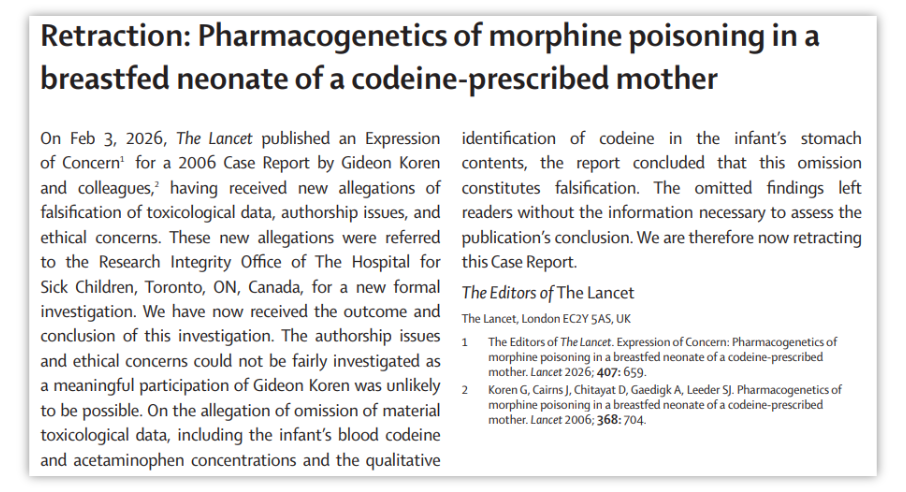
The Lancet has retracted a 20-year-old case report of an infant’s death by opioid poisoning via breast milk, following an institutional investigation that concluded the authors falsified the report by omitting key data.
The 2006 report described the death of a baby boy whose mother had been prescribed Tylenol with codeine, an opiate that gets metabolized to morphine in the body. The report’s first author, pharmacologist Gideon Koren of the Hospital for Sick Children in Toronto, used the case to claim for years that codeine, which gets metabolized to morphine in the body, can pose a lethal risk to breastfeeding infants.
That claim has been the subject of many articles in journals and the media, alongside scrutiny and investigations into Koren’s other work. In January, an article in the New Yorker brought renewed attention to Koren and the case report, and led a former Ph.D. student of Koren’s to come forward with new allegations about the case report. An expression of concern followed.
“On Jan. 20, 2026, The Lancet was contacted with new allegations” that “important toxicology data were left out of the paper,” a spokesperson for The Lancet told Retraction Watch by email. Those data included concentrations in the infant’s blood of codeine and acetaminophen, and the contents of the baby’s stomach.
The journal referred the allegations to the hospital. “SickKids conducted a formal inquiry which included new evidence presented,” a spokesperson for the hospital said in a statement, “and concluded that material toxicological data had been omitted from the published report and that the omissions may lead readers without information necessary to assess the publication’s conclusion.”
The spokesperson declined to provide additional details, but “the report concluded that this omission constitutes falsification,” the retraction notice says. Based on that finding, The Lancet retracted the case report.
The case has been cited 464 times, according to Clarivate’s Web of Science. It has served as a central piece of evidence in guidelines and recommendations regarding opioid prescriptions for women who have just given birth, including a drug safety announcement issued in 2017 by the U.S. Food and Drug Administration recommending against prescribing codeine for pain in breastfeeding women. Of the 19 papers cited in support of that recommendation, Koren was an author on seven of them, including the now-retracted case report.
“It is the foundational document in an entire branch of pediatric pharmacology that’s just been made up out of whole cloth,” pharmacologist David Juurlink, professor of medicine and pediatrics at the University of Toronto, told Retraction Watch. “There’s critical information, the acetaminophen and the codeine levels in that baby, that were not in the original publication. Had they been, it would have been obvious from day one that the interpretation was wrong.”
Koren resigned from the Hospital for Sick Children in 2015 following an investigation into Motherisk, a lab he founded that tested for perinatal exposure to drugs and alcohol, including for criminal and child protection cases. The investigation, prompted by coverage in the Toronto Star, found the Motherisk lab’s test results were “inadequate and unreliable,” the newspaper reported. Following the investigation, more than 400 of Koren’s papers came under scrutiny by the hospital.
Koren has six previous retractions, two of which were papers on the safety of codeine while breastfeeding.
For more than a decade, Juurlink has been one of the most vocal critics of the idea that the breast milk of a mother taking codeine could be toxic to her baby. In 2020, he and pharmacologist Jonathan Zipursky published a review outlining the unlikelihood of morphine toxicity occurring through breast milk. They calculated that the morphine concentration in a breast milk sample from the mother was relatively small, and the baby had a codeine — not morphine — blood concentration 100 times higher than would be expected from breast milk.
That 2020 review culminated in coverage in the Star and a request for retraction to The Lancet. as well as requests for retraction for columns Koren had written about the case in Canadian Family Physician and Canadian Pharmacists Journal. The two Canadian journals consulted two external experts and ultimately decided to retract the articles, based on “clear evidence that the findings are unreliable,” the joint retraction statement said.
The case got renewed attention in January of this year as the centerpiece of an article in the New Yorker, which discussed autopsy data and other evidence pointing to someone giving the baby the pain medication directly rather than through breast milk.
The article also discussed a second case report, “Baby boy blue,” published in Paediatrics & Child Health by Koren and colleague Michael Rieder, the only other published case report of possible opioid poisoning via breast milk. The magazine article described an encounter where Rieder told Juurlink the case was made up. Following inquiries to Paediatrics & Child Health, the journal issued a correction to “Baby boy blue” — and 137 other case reports — to denote they were all fictionalized.
Parvaz Madadi, a former Ph.D. student in Koren’s lab, was a frequent coauthor with Koren on studies of codeine and breast feeding, including the lead author of the two Canadian journal articles that were retracted. Madadi recently reviewed her past work and the 2006 case report, the New Yorker reported, and in January she wrote to The Lancet alleging that Koren falsified the infant’s toxicology data in the case report, and asked the journal to retract it. We have reached out to her for comment on the retraction.
Like Retraction Watch? You can make a tax-deductible contribution to support our work, follow us on X or Bluesky, like us on Facebook, follow us on LinkedIn, add us to your RSS reader, or subscribe to our daily digest. If you find a retraction that’s not in our database, you can let us know here. For comments or feedback, email us at team@retractionwatch.com.
内容来自 Retraction Watch,版权归原作者所有。
阅读原文 ↗