

Ottoline Spearman
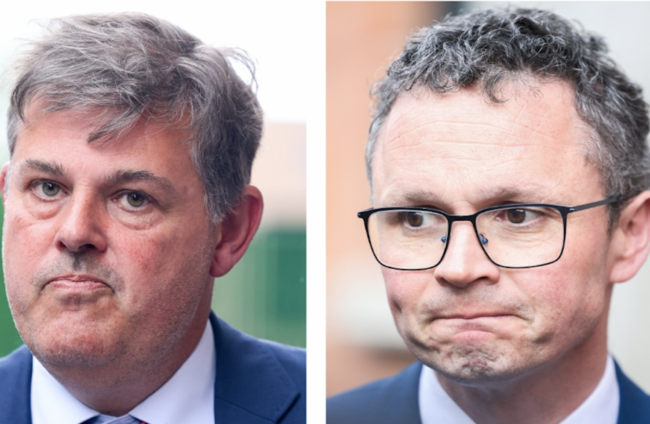
MINISTER FOR CULTURE Patrick O’Donovan warned Jack Chambers, the public expenditure minister, four days before the budget that the government would suffer “significant reputational damage” by “reneging” on its three-year funding deal with RTÉ.
In a letter from O’Donovan and his junior minister Charlie McConalogue to Chambers on 2 October, the ministers warned of a litany of impacts of being allocated €72 million less than asked for towards the Department of Culture, Communications and Sport’s budget for 2027.
Copying the Taoiseach and Tánaiste in their letter to Chambers, O’Donovan and McConalogue said these impacts would damage the government’s reputation.
They said the allocation of €827 million to the department would cut RTÉ funding for 2027 by €11 million.
It would also mean that there would be no increase in funding for Sport Ireland as the country prepares for the Olympics.
Any increased funding for high-performance sports would therefore have to come from funds diverted from the GAA and the FAI, the two ministers said in the letter which was released to The Journal under Freedom of Information.
They also warned of reduced funding for traditional music organisation Comhaltas Ceoltóirí Éireann “potentially impacting on next year’s Fleadh [Cheoil na hÉireann]“.
They added that the promised budget also meant there was “no possibility” of their department contributing to the costs of the National Centre for Research and Remembrance telling the story of Ireland’s Magdalene laundries and other institutions of detention.
They also said their department would also have to withdraw from any discussions with the NFL in relation to hosting further NFL games in Croke Park, with the possibility of hosting the Open golf championship also put at risk.
RTÉ row
The €20 million cut to RTÉ’s previously agreed funding announced in Budget 2027 was described by O’Donovan on budget day as a decision made in relation to RTÉ’s delivery of reform.
On budget day, O’Donovan denied that RTÉ’s budget was being cut, insisting multiple times when questioned by journalists that “there is no cut to RTÉ”.
“RTÉ will receive the same financial support from the government in 2027 as they did in 2026,” O’Donovan told a budget press conference.
However, in his letter to Chambers, O’Donovan himself described the planned changes for RTÉ as “a cut to RTÉ funding”.
This led to a stand-off with RTÉ director general Kevin Bakhurst who rejected the assertion that the pace of reform at the national broadcaster was too slow.
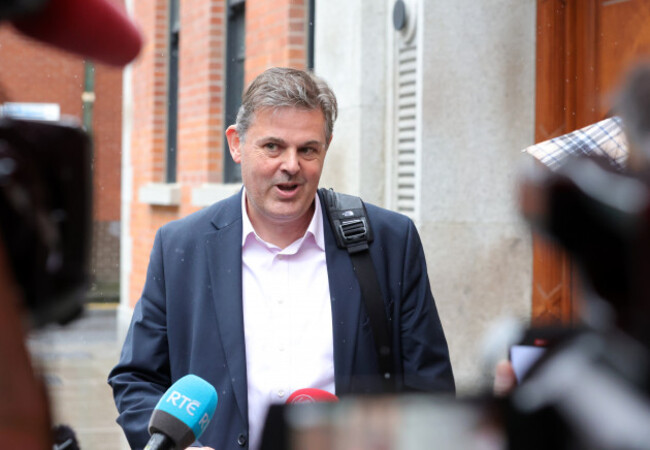
Bakhurst said later that he only found out about the cut three hours before the budget was announced, but O’Donovan’s letter shows the cut had been agreed days in advance.
In 2024, the government committed to providing public funding of €725 million to RTÉ from licence fee receipts and a direct top-up from the Exchequer over three years. Of this, €260 million was allocated for 2027. This was €20 million more than was subsequently announced in the most recent budget.
On budget day, O’Donovan said the €240 million allocation to RTÉ was a decision made “in the context of progress made by RTÉ in the delivery of their strategy”.
Speaking on budget day, O’Donovan said: “While progress has been made across a number of issues, I am not happy that we have seen sufficient progress in delivering the smaller, more agile processes that we sought to be delivered under the strategy.”
Responding, Bakhurst said: “We completely reject the assertion that the pace of reform and transformation within RTÉ has been slow.”
The department said on Friday that there is “ongoing engagement” with RTÉ on the funding question, adding that the funding question will be clarified when the Revised Estimates Volume is published by the Department for Public Expenditure in the coming weeks.
Budget proposal
O’Donovan and McConalogue said in their letter that their department had “substantially” reduced its budget ask from an initial figure of just over €899 million, to €879 million on 30 September, to a final offer of €858 million on 1 October – “despite misgivings about the impact on [their] services”.
Chambers’ department had subsequently offered €827 million. The final budget allocation was €858 million.
In its initial budget submission on 21 August, the O’Donovan’s department said that a “net increase of €20 million” would be needed for the government to be able to make good on the commitment to funding for the national broadcaster, stating: “We [the department] require funding to deliver on the government decision on financial support for RTÉ.”
O’Donovan subsequently met with Bakhurst a couple of days after the budget was announced, with reports that the meeting was “constructive”.
Department responds
The Department for Culture, Communications and Sport said in a statement that the leetter involved “setting out the implications for a range of initiatives and commitments under the Departments remit in the context of proposed 2027 funding level”.
It said that while O’Donovan had previously sought €260 million for RTÉ, “his decisions in this regard were primarily guided by the total funding available, and the need to balance a range of priorities across the Department”.
“The pace of reform at RTÉ was one factor in arriving at final allocations.”
They also added that the department “continues to engage with the NFL in relation to the hosting of future games in Ireland but no agreement has been finalised”.
“Any decision to provide public funding for a future game will require a Government decision,” they said.