
Silicon Valley’s reaction to the Nvidia drama is rife with blind spots
Hello again, and welcome back to Fast Company’s Plugged In.
Jensen Huang was scheduled to speak at this week’s Semafor Silicon Valley & The World conference, which he cochaired. For reasons too obvious to require explanation, he didn’t make it to the event. And yet he dominated the on- and off-stage conversation so resoundingly that it might as well have been titled “Silicon Valley, The World & Jensen Huang.”
As tech notables sat for interviews—among them Sam Altman, Clay Bavor, Jeff Bezos, Andy Jassy, Yann LeCun, Fei-Fei Li, and David Sacks—moderators kept requesting their take on Huang’s shocking ouster from Nvidia. Most lavished praise on his entrepreneurship, but begged off saying much more on the grounds that the circumstances remained murky. Bezos’s comments were typical: “I don’t know enough of the details and I think probably most of us don’t know. . . . What I can tell you for sure is that Jensen is a remarkable guy who founded and built a remarkable company.”
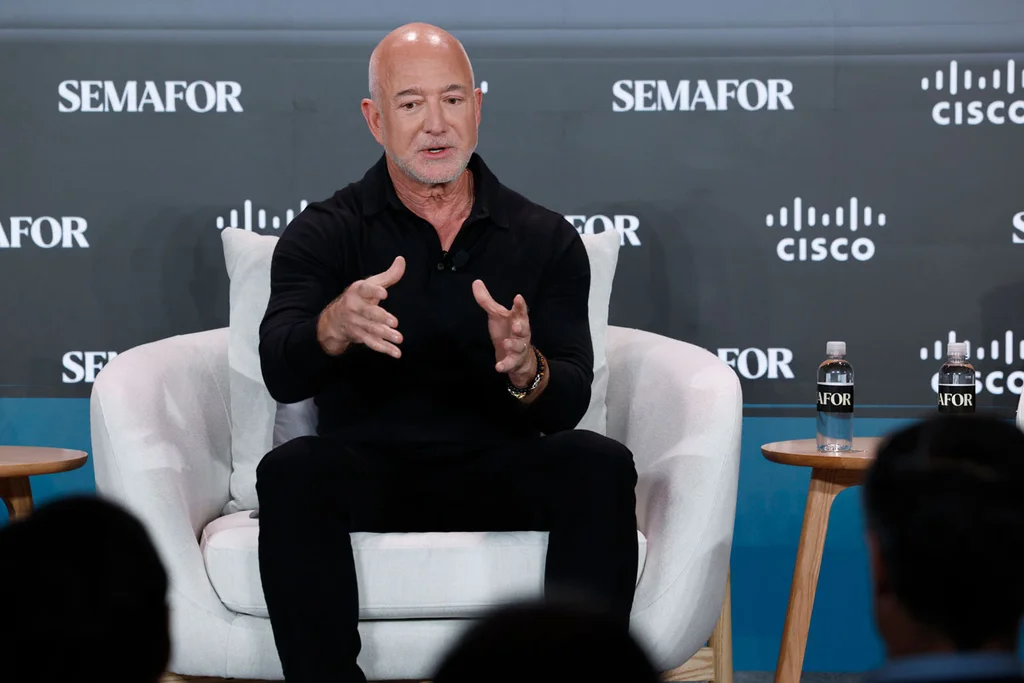
Speakers at Semafor’s event approached the subject more gingerly than many in the scrum on X where Huang declared on Tuesday that “if the Board of Directors decides that my return is in the best interest of our shareholders, our employees, the company, and America, I would be honored to answer these calls and return as CEO.” Skimming the 58,000 replies to his post, I didn’t see much discussion of the specifics of the case: Huang’s confessing to an extramarital affair with an Nvidia business partner who was allegedly also a spy for China, the questions that raised relating to Nvidia chips possibly being smuggled into China, and reports that he had two additional affairs with Nvidia employees.
Instead, Huang’s X followers mostly had his back. Tech industry celebs such as Aaron Levie, CEO of Box; Palmer Luckey, cofounder of Anduril; and Linda Yaccarino, former CEO of X, shared a few words (or emojis) of support. Others were civilians who expressed their enthusiasm for Huang’s theoretical rehiring in the form of truly weird AI slop: Jensen as Jesus at the Last Supper, Jensen popping out of a casket, Jensen lip-syncing Michael Jordan’s comments upon his return to the Chicago Bulls.
Despite reports of disagreement among Nvidia’s board members, the company continues to rule out Huang’s return. Given the unfolding legal and geopolitical elements of the story, a speedy Sam Altman-style reinstatement would appear to be fantasy in even the rosiest of scenarios.
The revelations thus far have already prompted the Trump administration to tighten restrictions on chip exports to China. Huang has agreed to testify before the Senate Banking Committee on December 1. Democrats, who will regain control of the Senate and House of Representatives in January, are salivating at the opportunity to dig into questions such as whether Commerce Secretary Howard Lutnick facilitated the diversion of Nvidia chips to China. And California’s attorney general has subpoenaed Nvidia in search of any evidence that Huang’s affair led to chips or confidential information making their way to China.
Bottom line: Everyone who says we don’t know enough to come to a firm conclusion about the precise nature of what happened and its appropriate repercussions is on far firmer ground than those who think Huang was unfairly forced out and should be welcomed back.
But for all the miasma of uncertainty clouding this drama, it’s already told us plenty about Silicon Valley. Its most admired, envied, seemingly essential CEO being shown the door, even as the company he cofounded is still booming, is a deeply unsettling black swan event, and I haven’t seen many in the industry unblinkingly confront its implications. It’s surely not a coincidence that Gina Raimondo, the former U.S. commerce secretary—who is a technocrat, but not a creature of the Valley—had the bluntest assessment of the situation I heard at the Semafor conference: “Any kind of corruption, politics, dealing with spies, [there should be] no tolerance for it.”
Paul Graham, cofounder of Y Combinator, coined the term “founder mode” in 2024. It celebrates startup founders who refuse to cede control to professional managers, regardless of how big their brainchildren become. Decades before the concept had a name, Huang exemplified it. Instead of growing more remote from the minutiae of the company’s operations as it became a behemoth, he had his hands in everything—which is how he wound up with a reported 60 executives answering directly to him.
Over Huang’s 33 years as Nvidia’s CEO, he took risks that no MBA-brandishing suit would have dared. None was gutsier than his 2006 decision to pivot from focusing on 3D graphics to building a high-performance general-purpose computing platform. That prescience paid off when artificial intelligence became an epoch-shifting opportunity, leading to the company’s 90% market share in the chips that power generative AI.
In recent years, as Nvidia has jockeyed for the title of the world’s most valuable company, Huang has been no less daring. Whatever you think of the AI industry’s “circular financing,” in which many players take financial stakes in their own customers, Nvidia’s willingness to write huge checks to companies in its own ecosystem has been critical to AI’s growth. And as expectations for the technology prop up the stock market, it’s not just the tech business that might look very different without Huang’s high-stakes gambling. So might the entire U.S. economy.
Huang the public figure has become as unique as Huang the fearless entrepreneur. Once an unassuming engineer in an Nvidia shirt who went by his birth name of Jen-Hsun Huang, he reinvented himself into the genially bombastic, leather jacket-wearing rock star I interviewed in 2024. Only Altman rivaled his omnipresence as a speaker at tech industry events. Huang, who relished engaging in stunts such as frolicking with robots onstage, was a lot more fun. I can understand why people who never met him take his downfall personally.
If you can’t envision a tech industry without Huang at its core, you have every incentive to wish for any possible outcome that would reinstate him to his previous eminence. But Huang himself took risks that made a happy ending far less likely.
All evidence indicates that his initial strategy for dealing with the mess he created involved misleading Nvidia’s management and board, not to mention members of the press. Huang’s undisclosed relationships seem to have violated Nvidia’s own code of conduct. I have seen many people argue that they should still be forgiven. But to my knowledge, nobody has explicitly maintained that a CEO lying to his board is tolerable, at least if that CEO is Jensen Huang. Maybe that’s because the case is impossible to make.
Another bad bet Huang made was his tight relationship with President Trump, which he was flaunting as recently as September. It apparently influenced the president to dismiss an October 2025 intelligence briefing on Huang’s relationship with Megaspeed’s Alice (no relation) Huang. Trump may not have been doing Huang any favors, given that the story blew up in both of their faces at the worst conceivable time, after the Democrats’ wins in the midterm elections.
As Daring Fireball’s John Gruber noted this week, tech executives have historically steered clear of hugging any political party so close that it would complicate their relationships in Washington, D.C., should the balance of power shift. Huang abandoned this approach during Trump’s second term. So did other executives, but only Elon Musk may suffer graver consequences.
Huang’s unplanned departure also left Nvidia scrambling to deal with a fundamental bug in the logic of founder’s mode. Any company that’s lucky enough to matter for decades will, at some point, be run by a nonfounder—maybe even a dreaded professional manager. Responsible founders, no matter how hands on, should prepare for that day. Many do not.
Along with everyone else in the Valley, Huang apparently couldn’t picture a post-Jensen Nvidia. I hope he was kidding when he said he’d like to run the company for another 30 or 40 years and then be replaced by a robotic version of himself. But his failure to establish any clarity around a succession plan is a deadly serious problem for the company he founded. (His daughter, son, and son-in-law all work at the company, but not in roles that leave any of them as an heir apparent.)
Nobody else in tech ever had a career like Jensen Huang. His present quandary is part of that story, but I don’t expect it to be his only legacy. He might even rebound in some manner that doesn’t involve him getting his old gig back. Assuming the mystery surrounding this chapter eventually subsides, I hope the facts of the matter leave the industry wiser—if sadder—about aspects of its culture that it usually does its best to ignore.
You’ve been reading Plugged In, Fast Company’s weekly tech newsletter from me, global technology editor Harry McCracken. If a friend or colleague forwarded this edition to you—or if you’re reading it on fastcompany.com—you can check out previous issues and sign up to get it yourself every Friday morning. I’m also on Bluesky, Mastodon, and Threads, and you can follow Plugged In on Flipboard.
More top tech stories from Fast Company
Anthropic’s IPO filing reveals a strategy to undercut its AI rivals
The company’s push to make computing cheaper and bring more of it in-house could give it a crucial advantage over OpenAI, Google, and other competitors. Read More →
This new scorecard shows whether your favorite retailer is using Flock cameras
The chart, released by Fight for the Future just before the holiday shopping season, urges readers to ask big chains to stop using vehicle surveillance technology. Read More →
An Eric Trump-backed startup unveils a powerful new humanoid robot—and won’t rule out arming it
Foundation’s Phantom MKII can carry 200 pounds and withstand harsh weather. Its CEO envisions a future for the robots on construction sites, in factories, and potentially on the battlefield. Read More →
Marc Andreessen has a surprisingly mundane prediction about AI’s impact
The venture capitalist said Monday that the economic impact of AI will be more muted than some think. Read More →
This farming game is designed to keep you off your phone
‘Island: Screen Time Control’ uses the addictive UI of idle gaming to encourage building better screen time habits. Read More →
‘No one asked for this’: AI is being pushed on people—and they’re sick of it
For many workers, artificial intelligence has increased frustration and job insecurity rather than productivity. Read More →
内容来自 Fast Company,版权归原作者所有。
阅读原文 ↗