
Parents are prioritizing screen-free gifts this season as research about potential harms to children piles up
As everyday technology becomes more advanced, parents are prioritizing screen-free, hands-on holiday gifts for children.
Forty-one percent of people buying gifts for kids in their family are leaning toward screen-free gifts, according to a survey by PwC.
A Germany-based brand called Tonies created an interactive, screen-free audio player designed for children.
The most well-known toy, called the Toniebox, is a squishy, cube-shaped speaker controlled completely by the child. Some models come with a hand-painted, magnetic figurine that automatically plays audiobooks, songs, or stories when placed on the box.
Last holiday season, the Tonies app hit No. 1 on the App Store. This year, the company saw a 33% increase in global revenue in the first nine months of 2026. Its biggest market is North America, capturing $315 million in revenue in 2025.
Concerns about screen use in childhood
Screen use in early years of childhood has shown potential to harm cognitive, linguistic, and social-emotional growth, according to a study from the National Library of Medicine.
Excessive screen use among youth has even been linked to a rise in likelihood of obesity, sleep disorders, and depression, and anxiety, the study found.
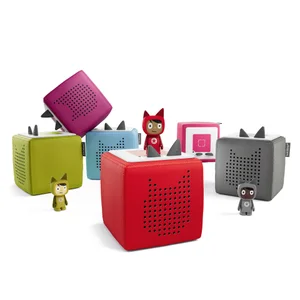
Screens have the potential to improve education and learning, when paired with parental controls and screen-time restrictions. But, Tonies offers a chance for children to interact with their minds rather than a touch-screen.
“Through listening, the key thing is, your imagination develops because you actually picture the dragon, you picture the knight, you picture whatever it is. It’s not just delivered for you,” Mark McColgan, general manager of Tonies in North America, told Fast Company.
The company started producing the Toniebox 10 years ago. As technology changes, the boxes remain the same and are built for long-term use, said McColgan, who joined Tonies this year from Mattel.
The boxes are a relief for busy parents, too. Sometimes parents need a moment to themselves, but offering a screen to their children for a short-term distraction can become a long-term addiction, and a source of guilt for parents.
Some parents have turned to screens to curb behavior in public, and sometimes, as a replacement for expensive childcare, a study from a hospital found.
“It gives them guilt-free time to do something else, because when their child is playing with the Toniebox, they know it’s a safe, good environment for them to do so,” McColgan said.
内容来自 Fast Company,版权归原作者所有。
阅读原文 ↗