
Billionaire Brad Jacobs says he’s still betting on homebuilding despite cyclical weakness
Want more housing market stories from Lance Lambert’s ResiClub in your inbox? Subscribe to the ResiClub newsletter.
Brad Jacobs says he’s just getting started. QXO, the building products juggernaut he’s forming, has grown to $18 billion in combined annual revenue in less than three years through a series of large acquisitions. On stage at ResiDay 2026 in New York City on November 6, Jacobs—America’s 98th wealthiest person, according to Forbes—made clear the roll-up is far from over.
“We’re nowhere near done,” said Jacobs, who has formed eight billion-dollar companies in the course of his career. “Our next stop will be $50 [billion], and we’re not going to stop there, either.”
That $50 billion goal leans heavily on supplying to homebuilders. During a conversation we had, Jacobs also discussed the soft housing market, tariffs, the data center boom, and why he thinks AI will reshape nearly every job in the industry.
Here’s what he said, and what it means for builders.
3 deals, 1 ‘one-stop shop’ for homebuilders
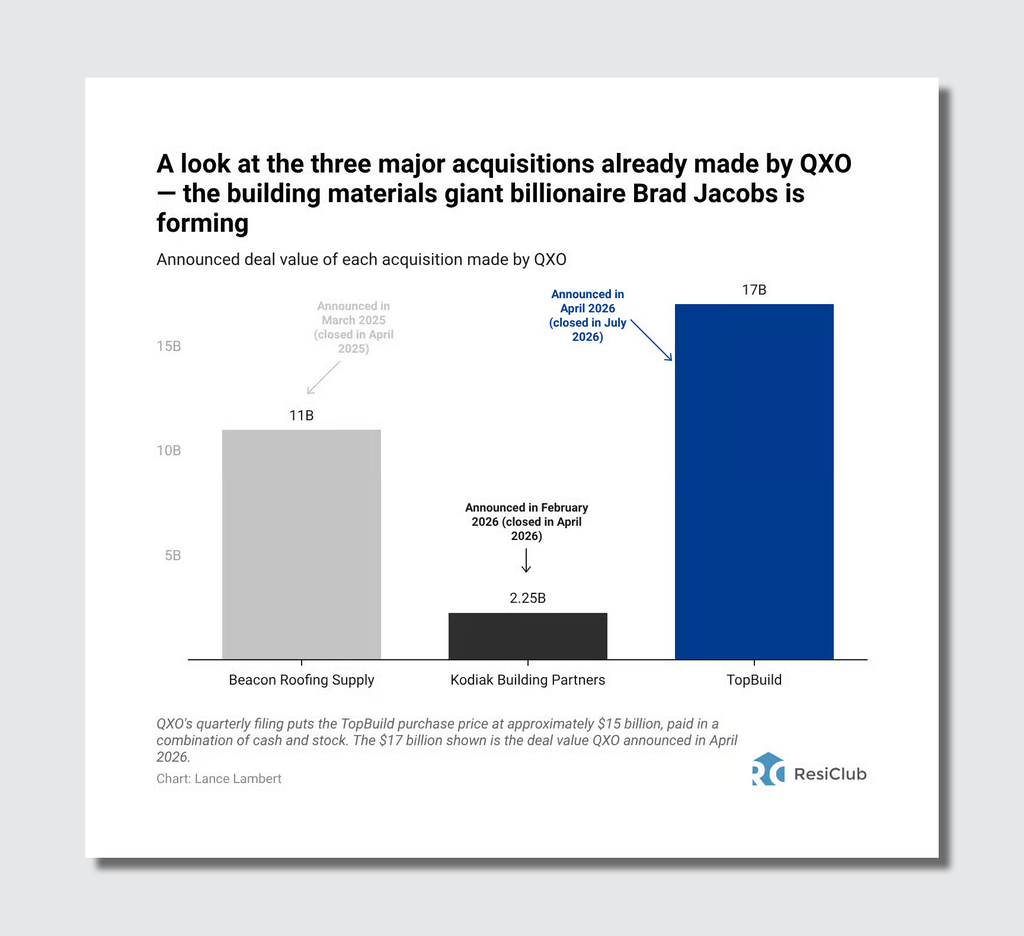
When I first spoke with Jacobs in October 2023, right as I launched ResiClub, he told me he planned to build a large building products distributor, mostly through acquisitions. That’s what he has done. QXO has completed three major deals worth roughly $30 billion combined. “We did exactly what we set out to do,” Jacobs said. QXO now has about 194,000 customers, 28,000 employees, and 1,150 locations.
The main reason to combine them is cross-selling. Jacobs said almost no QXO customer buys everything the company sells, but most buy many of its products. “There’s a huge opportunity to cross-sell and provide greater value to those customers by being a one-stop shop,” he said.
As for what QXO buys next, Jacobs said it will be opportunistic. “Pretty much anything along the spectrum of building products I like,” he said. Which categories come next, and in what order, “really is a little bit depending on what’s available and at what price.”
He also left the door open to buying a technology company, something QXO hasn’t done yet. At United Rentals, one of his first deals was a software company whose equipment-tracking system became the company’s core operating system. Buying tech, he said, gets a capability “overnight” that could take years to build in-house.
Homebuilders are QXO’s launchpad
Homebuilders sit at the center of the growth plan. On a November 9 conference call, three days after ResiDay, Jacobs said QXO is counting on homebuilders, an important and growing customer segment, as a launchpad toward $50 billion in annual revenue within the next several years.
The goal is to supply builders with far more than lumber and trusses. QXO has overhauled its sales incentives, technology, and pricing so it can become the primary supplier to both production and custom builders.
“Our strong relationships with production homebuilders are typically rooted in our truss and wall panel capabilities, as well as insulation, where we solve some of their greatest needs,” Jacobs said on the call.
The two most recent deals give QXO that foothold:
- TopBuild brought an installation business that is on roughly 22,000 job sites every day.
- Kodiak added lumber, engineered wood, doors, windows, trusses, and gypsum products.
To turn those relationships into bigger orders, QXO is changing how it pays its salespeople. The new compensation structure rewards employees for selling a broader range of products.
Jacobs says residential construction is ‘very soft.’ But long-term he’s bullish on construction, even with cyclical and demographic headwinds
Jacobs didn’t sugarcoat current conditions. “Short term has been very soft,” he said. “Markets are weak. There’s no question about that.”
He put most of the blame on affordability/mortgage rate shock, as average annual rates went from about 3% during the COVID-19 pandemic to 7% in 2023. (The average rate so far in 2026 is 6.6%.) But he sees it as a normal cycle. “These things go up, they go down,” he said. “Just wait that stuff out and keep on moving.”
Housing weakness isn’t stopping Jacobs’s dealmaking. Jacobs said he doesn’t try to time the market, and he buys throughout the cycle. “I’m not smart enough to figure out exactly where the bottom is, where the top is,” he said, adding that he tries to avoid buying at the “tippy, tippy top.”
Asked about Berkshire Hathaway’s recent push into residential construction, Jacobs agreed with the long-term bet. Warren Buffett “believes long term housing is a real good bet for the United States,” he said. “I agree with him.”
Jacobs said he deliberately tunes out short-term noise and focuses on a 5-, 10-, and 20-year view. What drew him to the industry is still there: it’s large—roughly $800 billion across the U.S. and Western Europe by his estimate—and still highly fragmented. And in this industry, he argued, scale pays off in procurement, pricing analytics, logistics, and the ability to afford technology.
“I’m not worried about the industry,” he said. “I think it’s an essential business that’s not going away.”
Tariffs: ‘Probably net negative’ for building
Jacobs called tariffs “good and bad.” He said they corrected some unfairness in trade terms, but also caused global disruption and strained relationships with allies, and added a fair amount of inflation in the U.S.
For building specifically, his verdict was clearer: “Probably net negative because it’s driven up the cost of building materials.”
Asked whether a quick rollback of tariffs after the midterm elections could disrupt a market just as it stabilizes, Jacobs said he hadn’t thought it through. But he said tariffs going away, under either political party, might be “a positive thing.”
QXO is riding the data center build-out wave
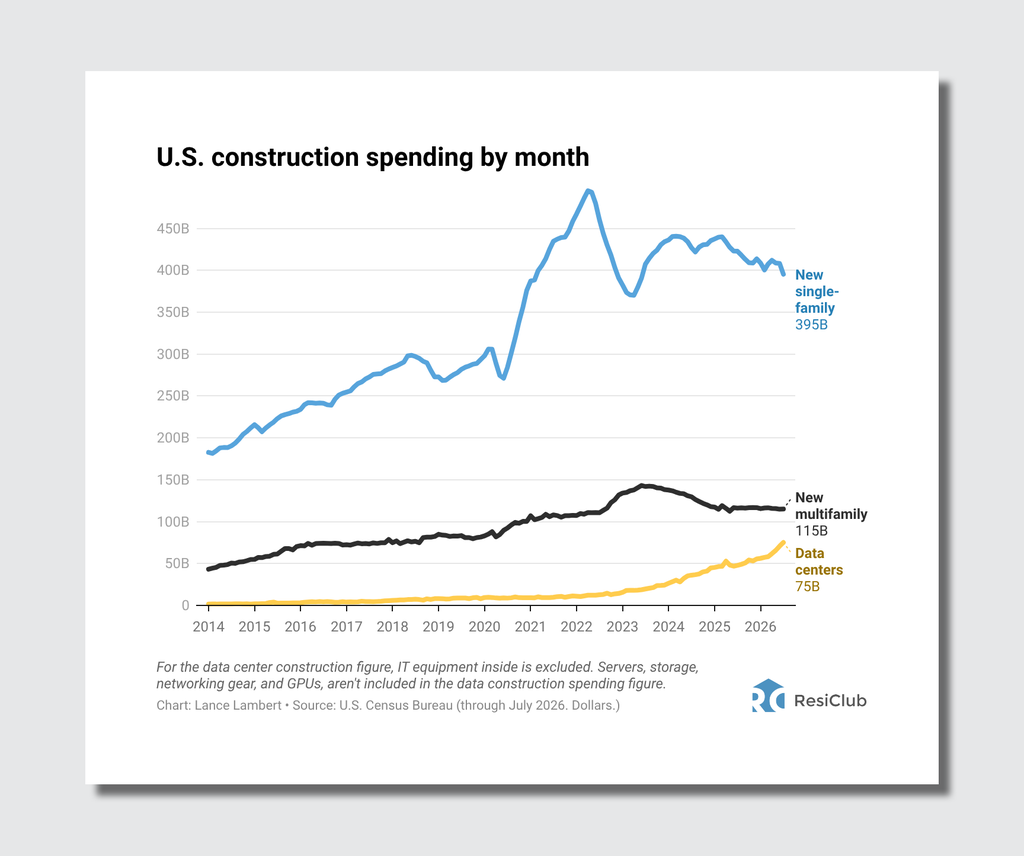
While housing is soft, data centers are QXO’s fastest-growing business. Jacobs said some of that business is growing about 40%, with visibility for the next few years. “Data centers is the real deal,” he said.
Well over 90% of QXO’s sales to data centers today consists of insulation, a business it inherited with TopBuild. “That was no genius insight from me,” Jacobs said. QXO is now the No. 1 supplier of insulation to data centers nationwide, he said.
The next step is cross-selling into those projects. Data centers buy nearly everything QXO sells, including roofing and lumber, with one exception. “Everything but windows,” Jacobs said. He admitted QXO’s data center roofing business is still small, but called it “a big thrust for us.”
He also expects data center construction to move away from population centers. Locating them near cities was “probably a mistake,” he said, pointing to higher water and electricity bills and traffic for nearby homeowners. He expects more projects in sparsely populated areas, including on government-owned land.
QXO already has AI bots running bids and awarding orders
QXO is spending “hundreds of millions of dollars” on technology, Jacobs said, and AI underpins all of it. He called it a long-term bet rather than a short-term return.
The first job is cleanup. All three companies QXO bought ran outdated, siloed systems, he said. Employees reentered the same credentials across systems and kept cheat sheets because the same stock-keeping unit (SKU) had different names in different systems. QXO is consolidating everything into one portal to save time for employees and customers.
That matters in an industry where, as Jacobs put it, most customers are behind schedule by 10 a.m. on Monday. Anything that saves them time adds value, he said.
Procurement is moving fastest. Jacobs said indirect procurement is headed toward no human involvement at all, and QXO has started using bots for direct procurement too. A bot can now set up a request for proposal, run the tender, and award it, with sometimes 200 vendors competing online. It can also help with logistics and invoicing, though it can’t fully handle logistics yet.
Asked how he got comfortable handing that much power to AI, Jacobs said: “I still haven’t gotten over it.”
Software development has changed just as fast. Jacobs said he once had about 1,200 people writing code in India and around the world, and couldn’t put that many to use today. He has watched QXO’s developers simply describe to the computer what they want built. Work that used to take a team a month now gets done in a couple of hours, he said. “It’s really a whole new world.”
‘You got to embrace it’: Jacobs’s AI playbook for leaders
Jacobs said this is the biggest technology shift he has lived through, and his advice to executives was blunt. “You got to embrace it. You absolutely have to embrace it,” he said. “The genie’s not going back in the bottle.”
Hiding from AI or fearing it is a waste of time, Jacobs argued. Instead, leaders should go through every single process in their company and ask what can be digitized, and where AI can save time and improve accuracy. In building products, Jacobs said, that includes:
- Procurement
- Sales and pricing
- Transportation
- Labor force management
- Product specifications
- Predicting customer needs
- Takeoffs
Jacobs also stressed that AI is only half the story. “Everyone keeps talking about AI, AI,” he said. “It’s AI plus the robots.” He expects humanoid robots to take on many jobs people do today, from teaching to therapy.
Asked by an audience member at ResiDay whether AI and robotics will unlock more value upstream or downstream in the supply chain, Jacobs answered: “Both.” He said it’s hard to think of any part of the building products supply chain that won’t be profoundly changed, and to a large extent replaced, by technology.
Yet Jacobs doesn’t think AI threatens demand for what QXO sells. Five, 10, or 20 years from now, people will still live and work in physical buildings, he said. “They’re going to need roofs. They’re going to need doors.” It’s the same bet he made with ResiClub in 2023, when he said residential construction “is not going to be replaced by a hologram.”
AI, jobs, and housing demand
Here’s a chart from a ResiClub report published in February 2026. If we updated the figures, it’d show a higher figure for San Francisco, given its upward pricing action this year.
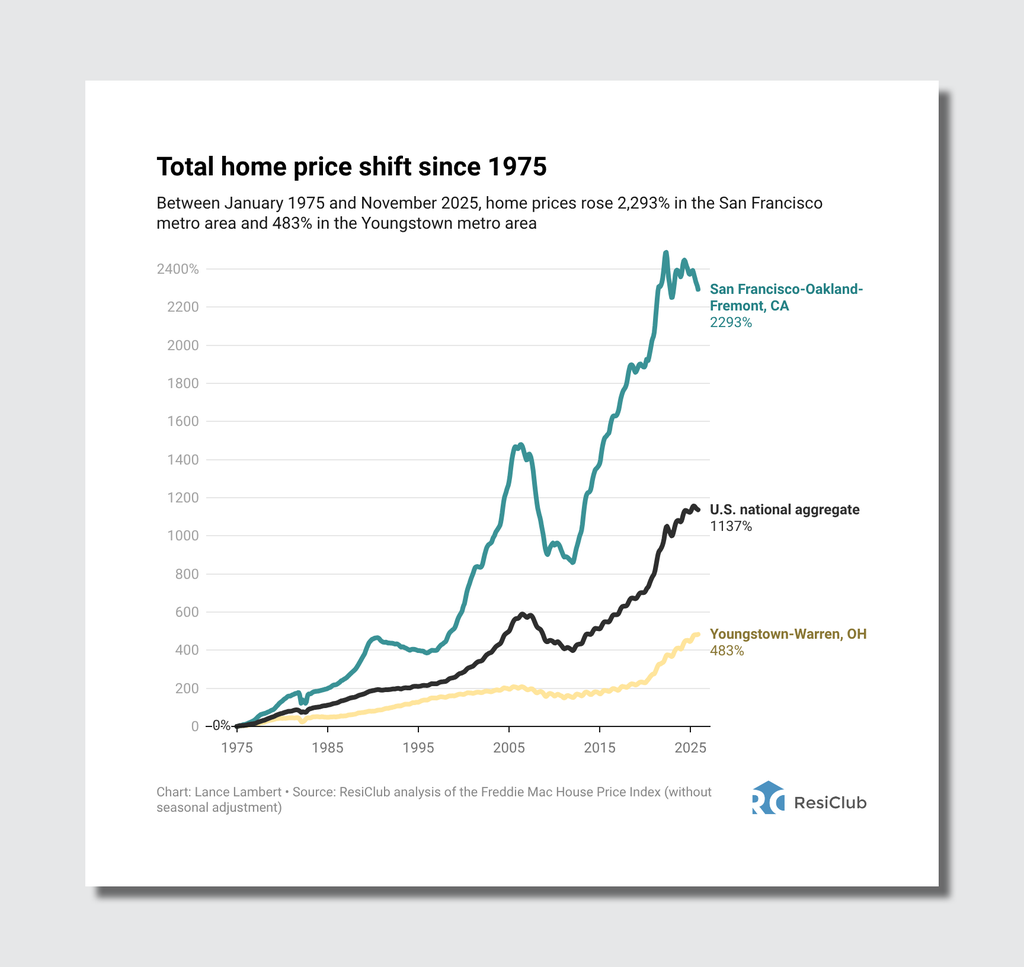
I pointed out that, since 1970, home prices have risen far faster in tech- and finance-driven markets that benefited most from globalization, like San Francisco, than in places like Youngstown, Ohio, which, on a net basis, lost out to globalization. Where AI takes the job market, including regional impacts, will shape future housing demand, too.
Jacobs expects big changes. He said many jobs done by people today will be done digitally or by AI-enabled robots, and that there will “absolutely” be fewer jobs. He also expects AI to drive “massive deflation” in the cost of goods and services, which he thinks could ultimately offset the job losses for the average person.
The transition will be rough, he warned. “If we handle this correctly, I think it’ll be good, real, real good,” he said. “But in the interim, there’s a lot of disruption.”
Jacobs’s advice for smaller building materials companies
Jacobs said he is bullish on small and midsize companies. Across the industries he has consolidated, the local players mostly didn’t disappear, he said, because owners stay close to their costs, customers, and employees. He thinks AI will “level the playing field to some extent,” giving smaller companies access to information that once only big companies could afford.
One audience member at ResiDay, Jason Chan, asked how he could grow his $20 million-a-year company, which sells concrete forming, erosion control, and landscaping materials, without acquisitions. Jacobs’ first answer: “I would sell it to me.”
Then he laid out his playbook:
- Size up the addressable market in the geography you want to win.
- Map your competitors and their advantages and weaknesses.
- Do a lot of customer interviews to learn what customers value and will pay for.
- Redesign the business plan so you beat the competition on exactly those things.
- Hire the best people you can, tie their pay to the plan, and get them thinking like owners.
- Make sure everyone is obsessed with service, whether that’s product availability, on time and in full delivery, or invoicing.
With 20 employees, Jacobs said, a small company has an edge over QXO’s 28,000: “You can find the 20 best employees in your area.”
Asked whether he’s always been this optimistic, Jacobs said yes. “If you’re upbeat and thinking about the positive things and opportunities,” he said, “you kind of figure out ways to make that happen.”
What it means for builders
Expect a much bigger QXO sales push on your job sites. QXO already ranks No. 1 in insulation, No. 2 in roofing, No. 1 in waterproofing, and No. 1 or No. 2 in lumber and building materials in key markets. QXO will keep pushing into more segments and growing its piece of the pie.
For builders, that cuts both ways. A one-stop supplier with installation crews on about 22,000 job sites a day could save time and simplify purchasing. But as distribution consolidates, builders, many already facing margin compression, are negotiating with fewer and larger suppliers.
QXO isn’t alone in courting them, either. Home Depot and Lowe’s have spent roughly $27 billion on pro-focused distributors since 2024, chasing the same builders and contractors. With Jacobs targeting $50 billion in revenue and saying he’s “nowhere near done,” the fight for the builder’s wallet is just getting started.
内容来自 Fast Company,版权归原作者所有。
阅读原文 ↗