
Researchers are making Lego-like lunar dust bricks for building on the moon
There are plenty of techno-fantasies about living on the moon, but what would these lunar cities actually be made from? Blasting concrete, rebar, and big, bulky construction equipment into space isn’t feasible, so some scientists are exploring how to build a base on the moon using what’s already up there: moon dust.
Research from the University of Arkansas found that regolith, the loose lunar dust that covers the moon, could be used to 3D print Lego-like bricks that could one day be used in the construction of permanent structures. Their research, written up by Wan Shou, an assistant professor of mechanical engineering; Cole McCallum, then an undergraduate; and others, was published in NPJ Advance Manufacturing in August.
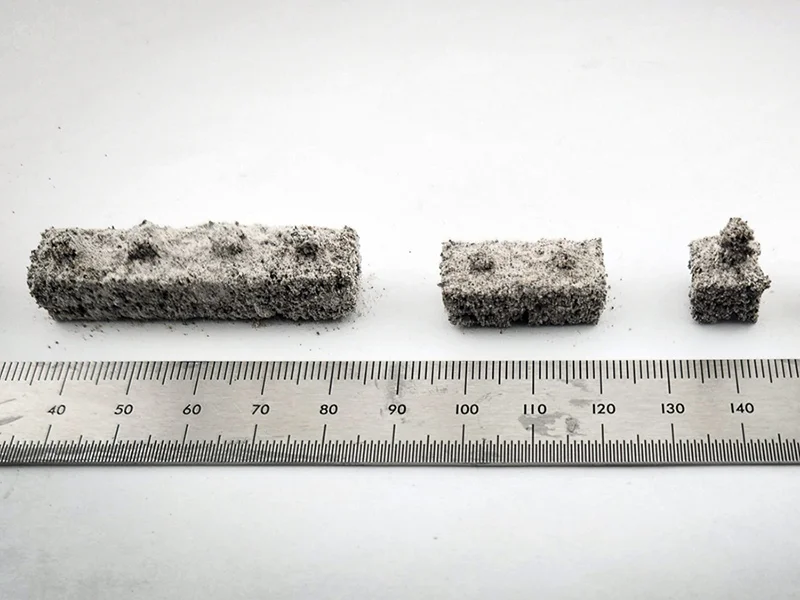
What makes 3D printing with locally available materials on the moon more difficult than on Earth is that the moon materials are harder to pack. This is because meteorites repeatedly crashing into Earth’s only natural satellite make its surface rough and jagged. There’s no wind or water to smooth things down, and nothing to bind the material together.
“Lunar dust is essentially finely broken rock,” Shou tells Fast Company. “Unlike typical soil on Earth, it contains no organic matter from plants or other organisms.”
Those irregular particles create a manufacturing challenge. They don’t spread and pack as evenly as the spherical powders commonly used in metal 3D printing, which makes it harder to produce uniform layers and consistent bonding.
Instead of actual moon dust, researchers used commercially available lunar regolith simulant, a synthetic material that approximates the way real lunar dust looks and behaves. To form the bricks, they used a form of 3D printing called laser powder bed fusion in which a high-powered light or laser fuses a fine layer of powder through a process called sintering. The team tested different laser conditions, then built thicker, multilayer specimens before forming several small interlocking bricks.
Other attempts to create building materials that would work with lunar dust have required additional binders, solvents, or processing materials. But the University of Arkansas researchers wanted to create with a method that was direct and binder-free so as to minimize the materials that would need to be transported from Earth.
To build on the prototype, Shou says they need to improve the bonding between layers, reduce defects, improve the mechanical performance, and refine the surfaces so the bricks can fit together more securely. From there, the next steps would be testing fabrication in a vacuum and with low gravity, as well as testing durability through repeated temperature changes.
“Making an interlocking brick is an encouraging first step,” Shou says. “A construction system will require predictable performance across both individual bricks and assembled structures.”
Shou says they envision that in the future, there’s a possibility of using concentrated light directly to do a similar fabrication. If it works, that’s a simple recipe for a basic structure made from just two ingredients: a moon base made from moon dust and sunshine.
内容来自 Fast Company,版权归原作者所有。
阅读原文 ↗