
Call for vigilance after Asian hornet sightings in Dublin
Updated / Thursday, 19 Nov 2026 14:16
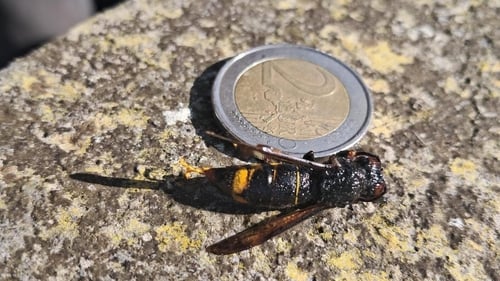
The public is being asked to watch out for Asian hornets after two confirmed sightings of the invasive species in Dublin city.
The first report of an Asian hornet was submitted from the Liberties on 8 November, with the second coming three days later on 11 November, from the Grand Canal Dock area of the city.
Both sightings were verified by the National Biodiversity Data Centre.
The national Asian Hornet Rapid Response Protocol was followed, and the National Parks and Wildlife Service undertook an extensive search and surveillance operation, involving multiple surveys and monitoring measures.
However, no evidence of a nest in the Dublin area was found. It is possible the Asian hornets that were sighted were isolated ones.
Listen: Beekeepers warn of threat to pollinators
We need your consent to load this rte-player contentWe use rte-player to manage extra content that can set cookies on your device and collect data about your activity. Please review their details and accept them to load the content.Manage Preferences
With temperatures dropping across Ireland, any remaining worker hornets are dying off, so active monitoring cannot continue.
People are being asked to educate themselves on what the Asian Hornet looks like and to keep an eye out when the weather becomes warmer.
Anyone who spots one should take a photo and report it.
Information on the Asian hornet, which is a significant threat to native bees and wasps, and how to report a sighting is available on the website invasives.ie.
'Constant monitoring required'
Eleanor Attridge, chair of the Co Cork Beekeepers Association, said the Asian Hornet is an invasive species "which is top of the food chain for our insects."
"It will actually attack our honeybees and our other pollinators and use that for feeding their own young."
"They are looking for protein sources so therefore are actually going to wipe out our normal pollinators or our natural pollinators in this country."
Following previous sightings in Ringaskiddy, Co Cork, and the subsequent removal of a hornet's nest, Ms Attridge described two new sightings in Dublin as "very concerning".
She said: "At this point of the year it's reproductive queens or drones that are more than likely in the area.
"If there's a nest in the area, that particular nest would have released those queens and drones, and the problem about that is, every nest that's there will release up to 300 queens which could set up new nests for 2027.
"So that area needs to be monitored and monitored again in the spring if they haven't found a nest, because those queens will now start to hibernate ... and they'll come out in spring, set up the nests and it will be too late then because they'll be established."
Ms Attridge said a "chance" exists to stop the spread but that "constant monitoring is required" by the "departments and by members of the public."
She said hornets measure about "three centimetres, they are about twice the size of a wasp" and can enter the country on a car bumper, on freight or "absolutely anything" from the UK and the European mainland.
"You can't stop them coming in but what you can try and do because we're an island is monitor them and try and keep them out," Ms Attridge said.
More stories on
内容来自 RTE,版权归原作者所有。
阅读原文 ↗