
Train driven above speed limit passed red signal in Cork
Train driven above speed limit 1.3km past red signal in 'high risk' incident
Updated / Thursday, 19 Nov 2026 14:20
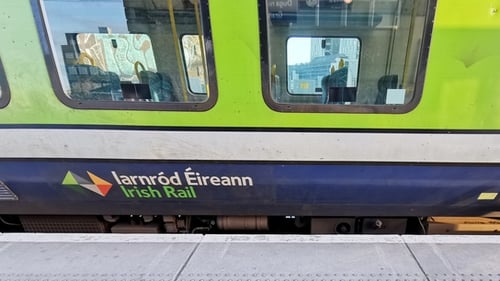
A train driver, who had been feeling unwell for several days, travelled past a red signal on the Tralee-Mallow line above the speed limit for 1.34km onto the main Cork-Dublin line before stopping last year in a "high risk" incident, an investigation has revealed.
A report by the Railway Accident Investigation Unit (RAIU) also found that a signalman alerted to the signal passed at danger (SPAD) had been unable to contact the train in seven attempts because the driver had inputted the wrong ID into a radio system.
The incident which occurred at Killarney Junction near Mallow, Co Cork on 8 February 2025 was classified as a "high-risk" SPAD. It was scored at 23 on a scale ranging from 0 to 28.
Under slightly different circumstances, according to the RAIU, the incident may have led to a serious accident with the potential for a fatality or serious injuries due to the risk of a collision with another train.
The report also highlighted several systemic issues including how rail safety still relies on the actions of drivers to respond to signals in the absence of a train protection system installed on tracks and trains which automatically apply the brakes if a speed limit is exceeded or a red signal is passed without authority.
RAIU investigators found the incident was due to the driver not responding appropriately to an earlier yellow signal by reducing the train's speed and by failing to stop the train at the red warning light which signalled danger.
The report revealed that the driver had operated a Mallow-Tralee passenger service without incident earlier that morning. However, they incorrectly inputted the train’s ID number before starting the return service at 1.05pm.
During the journey, the RAIU found that the driver exceeded the permissible speed of 113km/h between Rathmore and Banteer when the train reached 127 km/h.
The driver told investigators that they had been aware of over-speeding but did not report it as required, while they also inexplicably applied full brakes entering the station in Banteer, Co Cork.
Instead, they became focussed on complying with the speed restrictions for the remainder of the journey which the RAIU said may have resulted in a loss of situational awareness.
The report found the train passed the red signal at Killarney Junction at 2.33pm at a speed of 69km/h when the speed limit was 64km/h.
It continued for approximately 1.34km onto the Cork-Dublin mainline railway, causing over €3,000 worth of damage to the points system which was not set for such a movement.
It also prevented train movements on the Tralee line for the following 27½ hours leading to the cancellation of 19 trains with the cost of substitution buses totalling €4,100, as well as delays to other services.
After a signalman in Iarnród Éireann’s Centralised Traffic Control in Dublin could not contact the driver on the normal radio system because of the incorrect train ID, the report found they were also unable to communicate with the driver because they failed to press a "press to talk" button on an emergency system.
The RAIU said the driver’s health was also likely to have contributed to a number of his actions on the day as they had become transfixed with the train’s speed.
It noted the driver had a headache when they woke on the day of the incident after several days of a head cold and blocked sinuses, but felt better and fit for duty after taking a paracetamol and showering.
The driver told the RAIU that they were also conscious of other drivers off work and looking for time off that day and they did not want to disrupt their colleagues.
'Things started to go out the window'
However, the driver said they began to feel increasingly unwell after leaving Tralee when "things started to go out the window."
The driver, who subsequently tested negative for drugs and alcohol, said they stopped using a risk-triggered commentary technique that they had consistently used following a previous SPAD 11 years earlier.
The RAIU said it was not making any safety recommendations in relation to radio systems, driver non-technical skills or the train protection system because of measures currently in progress by Iarnród Éireann.
However, it did issue recommendations about issuing clear guidance for drivers who are feeling unwell and to assessing operational risk associated with SPADs at individual junctions.
The RAIU observed that an annual downward trend in SPADs had been reversed last year when 15 incidents had been recorded – the highest annual total in the past decade.
Since the incident Iarnród Éireann said it had issued a safety alert about the SPAD to all train drivers and a notice to signalmen about how to make emergency calls.
It is also carrying out a review of SPAD incidents over the past five years to consider if a similar event to the one at Killarney Junction could occur elsewhere on the rail network.
More stories on
内容来自 RTE,版权归原作者所有。
阅读原文 ↗