
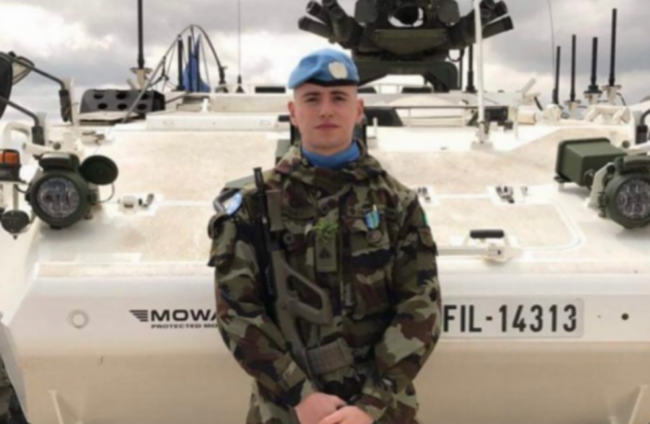
AN INQUEST INTO the death of Private Seán Rooney who was killed in Lebanon four years ago has heard how the military jeep he was driving was surrounded by angry locals, including men armed with AK rifles, after their vehicle became separated from a convoy heading to the airport in Beirut.
Another soldier in the vehicle, Trooper Shane Kearney, gave evidence about the fatal incident which resulted in the death of Pte Rooney (24), from Newtowncunningham, Co Donegal, near the southern Lebanese village of Al-Aqbiya while on UNIFIL duties on 14 December 2022.
The deceased, who was attached to the 27th Infantry Battalion at Aiken Barracks in Dundalk, Co Louth, suffered fatal gunshot wounds after their UN-marked vehicle was attacked by armed militia linked to Hezbollah.
The fatal incident occurred as two Army Toyota Land Cruisers carrying eight members of the Defence Forces were bringing Trooper Kearney and another soldier from their base in Camp Shamrock in southern Lebanon to Beirut for a flight back to Ireland after they had been granted compassionate leave due to deaths in their families.
Trooper Kearney, who comes from Killeagh, Co Cork, was giving evidence on the second day of the inquest into the death of Pte Rooney at Dublin District Coroner’s Court.
He described how their jeep, which was being driven by the deceased, became separated from the lead vehicle at EP28 – a UNIFIL border outpost near Tyre which marked the frontier of the UNIFIL area of operation at the Litani River.
Trooper Kearney said they had stopped at the post for an estimated 7–8 minutes as they were required to remove UN blue flags from their vehicles.
After the lead vehicle pulled off, he outlined how the second vehicle cut out as they were preparing to leave, and it took 2–3 minutes before it started again.
The inquest heard another vehicle passed through the crossing before them, which the lead vehicle might have believed was the one belonging to the convoy.
Trooper Kearney said they tried to catch up with the lead vehicle but believed it must have turned off somewhere as they were driving for 10–15 minutes without seeing it.
He then described how they arrived in a village where they quickly became aware they were not wanted.
He recalled locals became “very aggressive and hostile” with 50–60 people surrounding their vehicle after it had tried to turn around.
The inquest heard the bystanders were kicking and hammering on the jeep before a green van pulled up “with a roaring halt” from which three to four men got out bearing AK assault rifles.
Trooper Kearney also remembered a young man outside the vehicle with a pistol that did not have a magazine who returned a few minutes later with the weapon loaded.
He recalled how they were initially saying there was no need to panic as they were in a bulletproof vehicle before Corporal Josh Phelan indicated he would need to communicate they were “in a bit of bother.”
The witness said he and the other soldier in the rear, Trooper Nathan Bryan, were trying to keep Pte Rooney and Corp Phelan calm as they were “up the walls” after the rear window was smashed in.
Trooper Kearney said they thought help was going to come and realised they were in “a bad situation.”
He told the inquest that his next memory was “waking up in a hospital in Dublin.”
In reply to questioners from coroner Myra Cullinane, Trooper Kearney said he had not received any training about journeys leaving the UNIFIL area.
Asked if they had been provided with any guidance or rules before leaving, he replied: “Not that I remember.”
However, he said a basic rule was that Defence Forces members could not go anywhere in just one vehicle, while the lead vehicle would always “keep eyes” on the one behind it.
He said the two vehicles were travelling at just 20 metres apart up to the EP28 border post.
Trooper Kearney said they were trained “to an extent” about what to do in “denied freedom of movement” situations.
He explained soldiers were trained to first try and de-escalate a situation and then seek further assistance if that was not possible.
Trooper Kearney, who had been dressed in civilian clothes at the time, confirmed that he did have access to body armour which was stored in the boot of the vehicle.
The witness told counsel for Pte Rooney’s family, Seán Guerin SC, that they had not been given any specific information about a threat level before going on the journey and a recent incident in the area.
Trooper Kearney said he was not familiar with the convoy route, and he believed the only member of the convoy who had ever taken the route before other than as a passenger was the first-in-command, Captain David Kelly, who was in the lead vehicle.
The inquest heard briefings for such trips would normally be held in a company office in their camp with a second shorter “frago” briefing just before leaving.
Asked by Guerin if there had been a detailed briefing on the day of the fatal incident, he replied: “Not to my knowledge.”
Trooper Kearney said the incident where they were prevented from leaving the village lasted about 20 minutes.
“The last thing I remember is the car being shot at,” he added.
The inquest is continuing this afternoon.